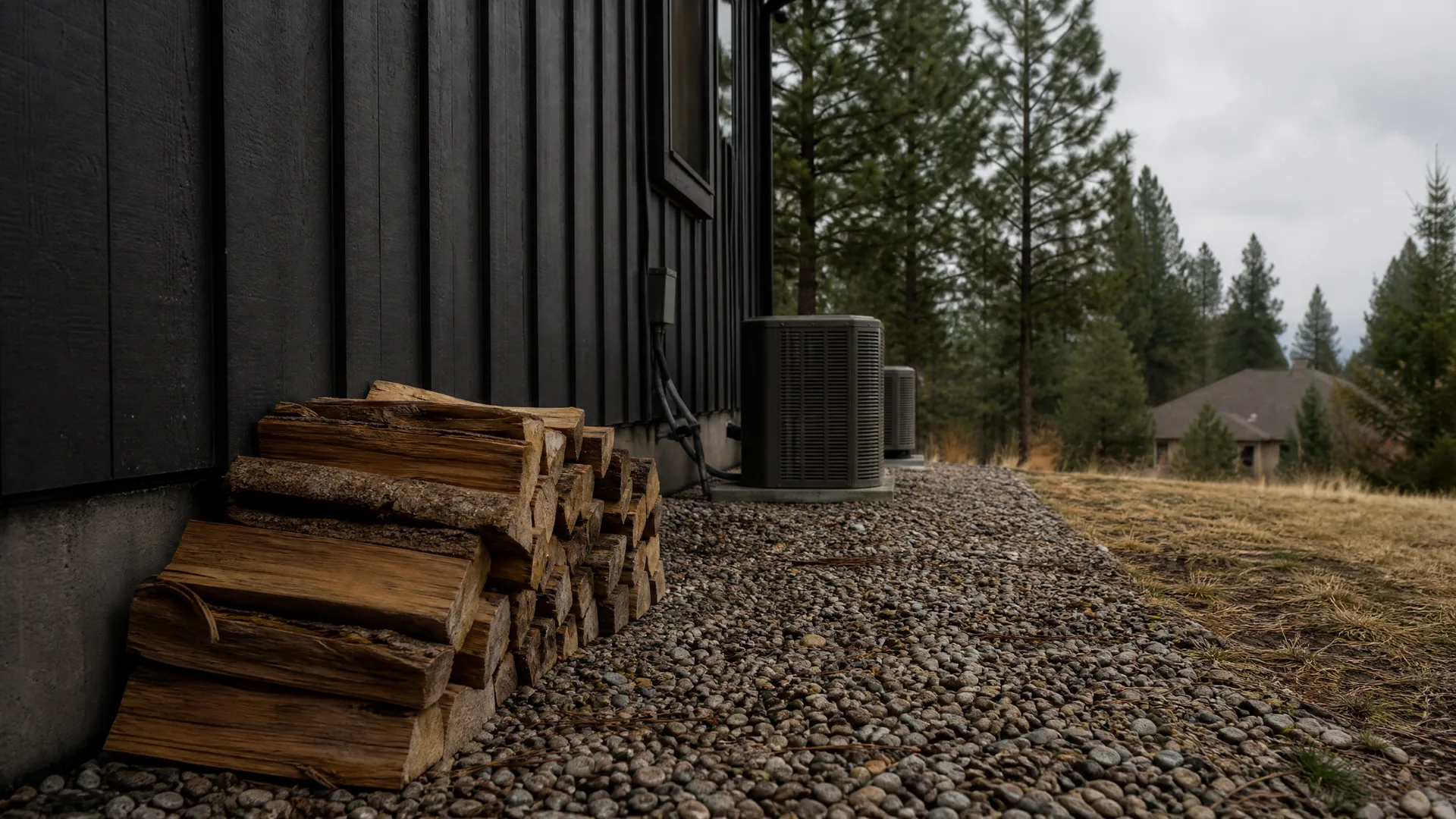






Stack of split firewood against the dark board-and-batten wall of a house, with two outdoor condenser units on a gravel strip, dry grass and conifer trees beyond under an overcast sky.

AC Repair in Rexburg, ID

Tell us about the job

Takes about a minute. No obligation.

RepairCentral ACMadison County, ID
Step 1 of 2

What ZIP code is the job in?

Your air conditioner really only earns its keep in July here. June and August stay mild enough that it barely has to run, and the afternoon high across those summer months averages just 79°F. That is not much heat for a compressor to fight against. A system working that little each year wears down slow, so when something does go wrong, it is usually one worn part rather than a machine that is used up. That makes most repairs worth doing.

1 months
July through July, your air conditioner is on duty
79°F
the average summer afternoon it cools against
5 hail events
in ten years, and hail bends the fins on outdoor coils
60 wind events
in ten years, and wind drives debris into outdoor units
Isometric line illustration of a cutaway house showing interior rooms with ductwork, an air handler and furnace, connected by lines to an outdoor condenser unit on the ground outside.
Your air conditioner works hardest from July through July.

NOAA nClimDiv, 1991–2020 normals

Half the homes in Madison County were built in 2002 or later.

A system installed with a house that age still has working life in it, so a repair call makes sense before anyone talks replacement.

July is the only month it has to work, and the only month trouble shows up

Cooling runs July through July
Summer afternoons average 79°F
60 damaging wind events from 2015 to 2024

Before anyone comes out, check the thermostat is set to cool and the setting is actually lower than the room temperature. Go outside and look at the condenser. If the fan isn't spinning and you don't hear any hum, check the breaker panel first, since a tripped breaker is the easiest thing to rule out. While you're inside, pull the air filter and hold it up to a light. If you can't see light through it, that's airflow the system has been fighting. Check the vents in each room too. Warm air blowing out when the system is running points to something different than weak airflow, and telling the contractor which one you saw helps them know where to start.

Call for a repair, not a replacement

Get a technician out to look at it rather than planning around a new system. A furnace or AC installed with a house built in 2002 or later still has working life in it, and whatever's acting up now is more likely one part than a machine at the end of its run.

Find a contractor
A man seen from behind, wearing a dark long-sleeved shirt and brown pants, carries a canvas tool bag as he steps up wooden porch stairs toward a green front door, with a potted plant beside the entry.
A gray cylindrical air conditioning condenser unit mounted on a concrete pad next to a light-colored vinyl-sided house exterior.

What actually gives out

The parts that fail most in an AC are the ones that start something moving. The capacitor gives the compressor and fan motor the jolt they need to get going, and it weakens a little more with every cycle until one day it can't do the job. That shows up as a unit that hums but won't start, or a fan that needs a push. The contactor is the switch that sends power to the compressor, and its contacts pit and burn over time until the system stops answering the thermostat. Neither of these wears out from the compressor running long hours. They wear out from switching on and off, so a system that cycles on and off a lot sees the same wear as one that runs for long stretches. A dirty coil or a clogged filter causes trouble a different way, by choking airflow and forcing the compressor to work against pressure it wasn't built for. Keeping the filter clean is the one thing that actually slows this kind of wear down.

What you'll notice first

The system runs longer than it used to, or it cycles on and off every few minutes instead of settling into a steady run. Rooms that used to cool evenly now have one that lags behind. The air at the vent feels less cold against your hand than you remember. These show up before anything stops working outright, and they're the reason to call before the unit quits on a hot afternoon.


What it means for the call

Tell the contractor exactly what you noticed and when, not just that something's wrong. A fan that hums without turning points at a different part than warm air coming out of the vents. A system that short cycles points somewhere else again. The more specific the symptom, the faster a technician knows which part to check first instead of testing the whole system from scratch.

Overhead view of a gray residential air conditioning condenser unit mounted on a concrete pad beside a house with asphalt shingle roofing.

A new air conditioner would save little on running costs in Madison County, so the repair decision comes down to the unit's condition.

  • An older air conditioner$60 a year
  • A new one at the federal minimum, 13.4 SEER2$60 a year

Estimates for a typical Madison County home, compared with an older unit built to the previous federal minimum, from EIA household energy data, Idaho fuel prices and NOAA climate normals. Your home will differ.

Repair makes sense when a part like a capacitor or contactor has failed.

Replacement makes sense when the compressor has failed or the system uses R-22 refrigerant, which is no longer made.

Repair or replace usually comes down to what's actually broken, not how old the unit looks. A capacitor, a contactor, a blower motor, these are standalone parts, and swapping one doesn't touch the rest of the system. The compressor is different. It's the one part that can't be swapped on its own for anything close to reasonable cost, since a new one often runs close to the price of a new outdoor unit. So the real question a technician is answering isn't how old the system is, it's which part failed. If it's a capacitor or contactor, that's a repair, plain and simple. If the compressor itself is going, that's the conversation where replacement starts to make more sense than throwing money at a dying unit.