
AC won't turn on in Boise City, ID

Get matched with someone who does this kind of work in Ada County.

Get matched

When your AC won't turn on, start with the thermostat and the breaker before anything else. Set it well below room temperature and listen for a click. If nothing happens, check the breaker panel. Summers in Boise City push an AC hard for months, and that strain is what wears out a capacitor or a contactor, the parts that actually get the compressor and fan running. A tripped breaker that won't reset, or one that trips again right away, usually means one of those parts has failed or the compressor is drawing too much power trying to start. Outside, the condenser unit should be free of debris and the fan should spin freely. If the thermostat has power, the breaker holds, and the unit still sits silent, the problem is inside the electrical components or the compressor itself, and that calls for someone who can test it safely.

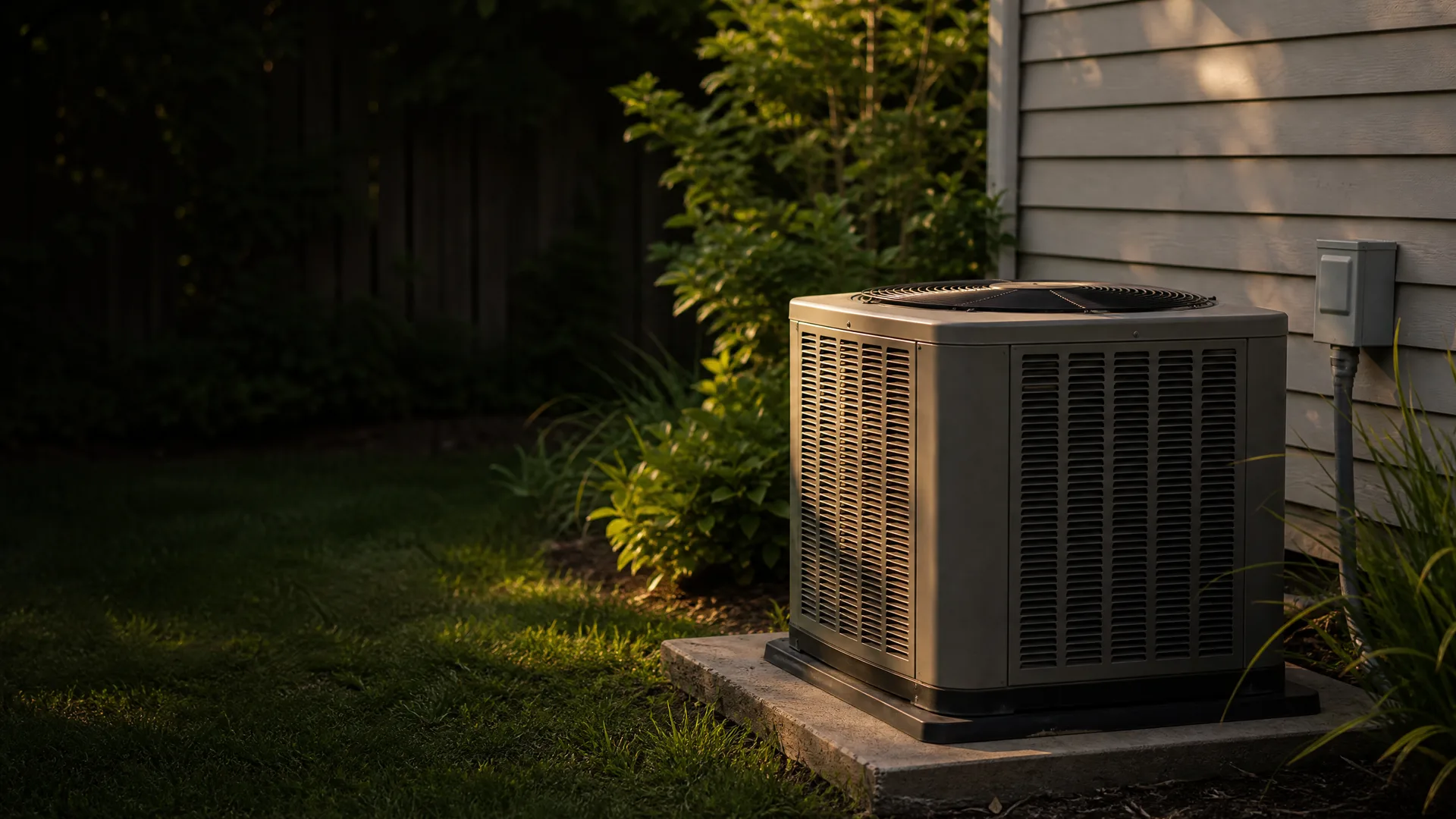
An outdoor air conditioning condenser unit on a concrete pad beside a house with horizontal lap siding, with a gray electrical disconnect box and conduit on the wall, mulch bed and shrub to the right, and mown grass in the foreground.

Running the way it should

A unit like this cycles on, runs its course, and shuts off without you thinking about it. The disconnect box stays closed, the coil guards stay clear, and air moves through the fins instead of around them. That's what lets the breaker and thermostat checks actually work.


An outdoor air conditioning condenser unit on a concrete pad beside a house with light blue horizontal siding, with a shrub to the left and a conduit and disconnect box on the wall to the right.

A unit that won't cooperate

Dust packed into the coil guards blocks airflow the condenser needs to dump heat. The unit can draw power and still trip out or run without cooling, which looks the same from the thermostat as power never reaching it at all. That's a job for a contractor, not another breaker reset.

A bearded man in a navy long-sleeve shirt sits smiling on a gray sofa in a living room, with a bowl of popcorn on a side table in the foreground and a shelving unit, potted plant, and kitchen area behind him.
A smiling man in a navy long-sleeved shirt reclines on a gray sofa in a living room, with a wooden bowl of popcorn in the foreground and shelves and a potted plant behind him.
A smiling man in a dark green sweater sits on a tan leather sofa in a dimly lit living room, with a bowl of popcorn in the foreground and a kitchen area blurred behind him.
A smiling man in a dark navy sweater sits on a light sofa in a living room, with a glass bowl of popcorn on a wooden coffee table and bookshelves behind him.

Your thermostat doesn't run the compressor directly. It sends a small signal to a control board, which closes the contactor, and that's the switch handling the real power your compressor and outdoor fan need. When a contactor pits or sticks, the rest of the system can be perfect and nothing still happens. There's also a float switch sitting near the indoor coil, and its only job is to cut power if the condensate line backs up. It doesn't care that your compressor is fine. Capacitors are another common stop. They give the compressor and fan motor the push to get spinning, and a weak one often means you hear a hum but nothing turns. Outside, near the condenser, there's a small pull-out box called the disconnect, and it's sometimes left open or knocked loose after service. Last thing worth knowing: if a breaker trips again after you reset it, something is drawing too much current downstream, and resetting it a second or third time won't change that.

What actually stops a unit

  • A thermostat calling for cooling sends a low voltage signal to a control board, which closes a relay called the contactor.
  • The contactor is what actually switches the 240 volt power that runs the compressor and the outdoor fan, and a stuck or pitted one won't close.
  • A float switch near the indoor coil shuts the whole system down if the condensate line backs up, even when every other part is fine.
  • Capacitors give the compressor and fan motor the jolt they need to start spinning, and a weak one leaves the unit humming instead of running.
  • The outdoor disconnect, a small pull-out box near the condenser, breaks the circuit for service and sometimes gets left open or knocked loose.
  • If the breaker trips more than once after you reset it, something downstream is pulling too much current and resetting it again won't fix that.
A gray outdoor air conditioning condenser unit on a concrete pad beside a house with horizontal siding and a stone veneer base, with refrigerant line and electrical disconnect box on the wall and flowering shrubs to the left.
A clean condenser like this one pulls air through the fins with no resistance, so the compressor isn't working harder than it has to.
An outdoor air conditioner condenser unit on a concrete pad beside a house with light gray horizontal siding, with mulch and green shrubs on either side and a concrete walkway in the foreground.
Years of dirt packed into the fins and casing choke airflow, and a unit that can't breathe will trip its own safety switch instead of starting.
An outdoor air conditioner condenser unit sits on a concrete pad beside a house with horizontal lap siding, surrounded by grass and shrubs in low evening light.

You're out back around seven, the heat finally letting go of the day. The condenser sits against the fence where it always has, and it's quiet in a way that catches you wrong. No hum, no fan turning behind the grille. You crouch down and the blades are still, dead still, no click from inside the unit either. Light's going gold over the yard, the kind of evening you'd rather spend with your feet up than standing over an AC that won't run. You already tried the thermostat. Somewhere past this moment, someone who knows this unit will have a look and tell you what it needs.

Get matched with an air conditioner pro in Ada County

Get the air conditioner repair search off your mind today.

There's no charge for the request.

Why the breaker trips at all

A compressor draws the most current the moment it starts, more than it needs once it's running. If that start-up draw is higher than it should be, the breaker trips to protect the wiring before anything gets hot enough to matter. A breaker that holds for a few minutes and trips again isn't a weak breaker. It's telling you the compressor is pulling too hard to start, often because a capacitor that's supposed to give it that initial push has weakened. Flipping the breaker back on over and over doesn't fix what's making it trip. It just delays a contractor finding the actual cause, and in Boise City's summer heat, that delay is the part that costs you.

What a dead disconnect box tells you

The gray box mounted next to the outdoor unit holds a pull-out block that breaks the 240 volt circuit to the compressor and fan. It's there so a contractor can cut power at the unit itself rather than back at the panel. If that block has worked loose, or moisture has gotten into the box and corroded the contacts inside, the unit can sit there with power at the breaker and still get nothing at the compressor. It's a small, enclosed box, easy to overlook because nothing about it looks like a switch. Checking it costs you nothing more than popping the cover, and it rules out one specific reason the outdoor unit stays silent.

Cooling runs June through August

Three months is the whole job for your AC here, June through August. That's a short window to find out the unit won't start, with the rest of the year to ignore a problem that needs fixing now. When it quits in July, there's no slack left to put off calling someone.

NOAA nClimDiv 1991-2020

Why Your AC Won't Start

  • Check the thermostat setting and the breaker before assuming the unit itself has failed.
  • A tripped breaker points to a hard-starting compressor, not a problem with the wiring.
  • A stuck or pitted contactor stops the 240 volt power from ever reaching the compressor and fan.
  • Dirt packed into the condenser fins chokes airflow until the unit trips its own safety switch.
  • A silent, motionless condenser on a hot evening usually means power isn't reaching it at all.
  • Finding the cause early in June through August leaves no room to put off the repair.

Start simple. The thermostat and the breaker catch more of these than people expect, and both take a minute to rule out. Past that, the problem usually sits in one of two places. The contactor is a small switch that takes the 240 volt power to the compressor and fan, and if its contacts are stuck open or burned through, that power never gets there. The unit looks dead because, electrically, it is. The other common cause works from the outside in. A condenser packed with dirt can't move air through its fins, and when it can't breathe, it trips its own safety switch rather than run itself into damage. That looks like the same silence and stillness as a bad contactor, but the fix is different. A tripped breaker tells its own story too. Compressors draw a heavy jolt of current the moment they start, more than they need once running, and if that start-up draw climbs too high, the breaker trips to protect the wiring. That points at the compressor, not at the breaker or the wiring behind it. None of these need guessing once someone's looking at the unit directly. Summer here runs June through August, and a dead AC on a 95 degree evening in Boise City doesn't leave room to wait it out. Whatever the cause, it's worth finding now rather than later in the season.

A woman with dark hair in a bun reclines on a light gray armchair with eyes closed and a slight smile, wrapped in a knitted beige blanket, with a lit table lamp, plant and dark green book nearby.
A man in a dark gray sweater sits smiling at a dining table with a glass of red wine, plates of salad, a candle in a holder, and a glass of water, with a window, lamp and houseplant behind him.

Air Conditioner Repair

Find an air conditioner repair pro in Ada County

Once you send the form, finding a pro is off your list.

A black-framed smartphone standing upright against a plain light gray background, its screen filled with solid green.
RepairCentral ACAda County, ID
Step 1 of 2

What ZIP code is the job in?