
Why your mini split light is blinking in Idaho
Why is the light on my mini split blinking?
You noticed a light flashing on the indoor unit and you're not sure if it means something is actually wrong or if it's just the unit cycling normally. With summer heat putting real hours on the system, a blinking light after a day of steady running is enough to make you want an answer before it turns into something worse.
It's an error code, and the pattern of blinks tells you which one
A blinking light on a mini split is the unit reporting a fault code through a sequence of flashes, not a random glitch. Each brand reads its own pattern differently, so the number of blinks and the pause between them point to a specific problem, like a frozen coil, a drainage issue, or a sensor that's failing. With Idaho summers pushing the system hard for months at a stretch, components work harder and a fault is more likely to surface now than in a slow month. The light itself won't tell you the fix. It only tells you where to look, and reading the code wrong can send a repair in the wrong direction, so it's worth having someone who knows the specific model check it before parts get swapped unnecessarily.
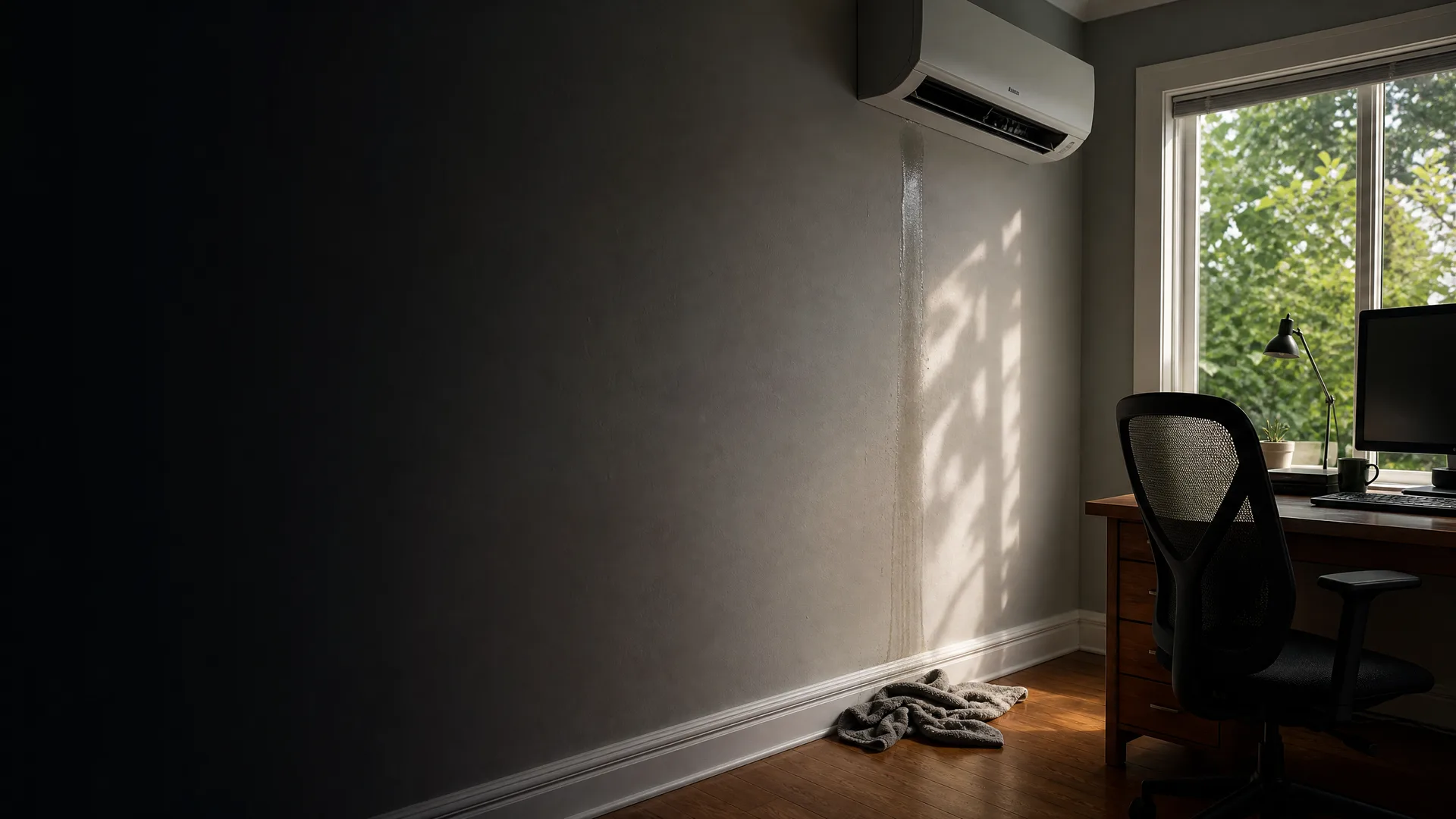
You're at the desk by the window, trying to get an hour of work done before the afternoon heat sets in. The mini split has been running most of the day, same as it has since June. You notice the wall under the indoor unit looks dark, then wet, a thin streak working its way down toward the baseboard. You grab a towel and press it against the drywall, then step back and watch the light on the unit still blinking away like nothing's happening. The room is cool. The wall isn't supposed to be wet. You stand there a minute, towel in hand, trying to decide how bad this actually is.


Reading the Blink Code
- The blink pattern is a count, not a random flash, and the indoor unit repeats it in a steady loop you can time.
- A control board on most mini splits stores a fault code, and the blinking light is the only way it has to show it to you without a screen.
- Some systems pair the light with beeps from the indoor unit, and the number of beeps usually matches the number of blinks.
- A long pause separates each repeat of the sequence, so counting from the start of one group to the start of the next gives you the real number.
- The outdoor unit can shut itself down mid cycle when the indoor board reads a fault, which is why the air stops before the light ever changes.
- Manufacturers assign their own codes to the same blink counts, so the same number of flashes means something different brand to brand.
The indoor unit is trying to tell you something specific, not just flagging that it noticed a problem. Inside the unit, a control board watches temperature sensors, the fan motor, the drain system and the connection to the outdoor unit. When one of those readings falls outside what it expects, the board can't show you a message, so it falls back on the only signal it has: the light. It blinks a set number of times, pauses, then repeats the same count again. Some units add beeps that match the blink count, which makes it easier to confirm the number if the light is hard to see clearly from across the room. Time it from the start of one sequence to the start of the next rather than trying to count during the pause, since that's where people lose track and end up with the wrong number.
That number points to a fault code, but the code itself isn't universal. A board built by one manufacturer assigns its own meaning to five blinks, and another manufacturer uses five blinks for something else entirely. This is why the outdoor unit sometimes cuts off mid cycle with no warning. The indoor board reads a fault, shuts down the outdoor compressor to protect it, and only then starts blinking. Getting the exact count, and knowing the brand on the indoor unit, gets a contractor to the right fault a lot faster than describing what the air feels like.


Finding a pro stops being your job
Only one pro gets your request, so you hear from one company.
Get the mini split repair search off your mind today.
It costs nothing to send, and you don't have to hire anyone.




Wait It Out or Call Someone
Watch it a while
- A single short beep when you first notice the blink is often just the end of a defrost cycle, and the light goes solid again on its own.
- If the air coming out is still cold and the unit cycles off and on like normal, the blink may clear once that cycle finishes.
- Checking the filter yourself costs nothing, and a clean filter rules out one of the most common reasons the light starts up.
- Idaho summers put the compressor under long stretches of work, and some blink patterns are the unit flagging a routine high-pressure moment rather than a failure.
- Waiting a day costs you nothing if the unit is still cooling the room and the blink pattern hasn't changed.
- If the light stops on its own within a day, you likely never needed a visit at all.
Get it looked at
- A blink pattern that repeats the same count night after night is the board telling you the same fault keeps happening, not a one-time blip.
- If the air coming out has gone warm or weak along with the blinking, the system is no longer doing the job you're paying power for.
- A wet or discolored patch on the wall below the indoor unit points to a drain line problem a filter change won't fix.
- Refrigerant and electrical faults behind these codes aren't something to open up yourself, since the system runs on a sealed charge and line voltage.
- A local contractor who works on mini splits all summer reads these codes often enough to know which ones mean a quick fix and which mean a part on order.
- Sending one request gets you matched with one licensed local contractor, so you're not juggling calls from several companies trying to sort out who's coming.

Idaho air stays dry through summer, with a dew point that averages 42°F across June, July and August, according to NOAA climate data. Dry air like that lets a mini split pull heat out of a room without fighting much moisture, so the indoor coil doesn't stay wet the way it would somewhere humid. That matters for the blinking light because a coil that drains properly rarely trips a drain or float sensor fault, the kind of code that shows up as a steady blink pattern. If you're seeing one anyway, the dry summers here make a clogged filter or a dust-packed coil a more likely cause than a drainage problem.
NASA POWER T2MDEW county cells weighted by homes


Why the code needs a tech
A blink count points to a fault, not to a part. The same three flashes can mean a sensor reading out of range, a clogged coil, or a communication break between the indoor and outdoor unit, and the only way to tell which one is happening is to open the unit and test it. Guessing from the code alone, or from a chart found online, usually means buying a part that was never the problem. A contractor who works on these systems every summer in Idaho carries a meter to check the sensor directly and knows which faults show up most on the units running hardest through the dry heat here.
Dry heat still strains the system
Idaho summers ask a mini split to run long hours against hot, dry air, and low humidity does not mean low load. The compressor and the fan motor still put in a full day's work from June through September, and a system running that many hours a day has more chances to trip a sensor or build up dust in the coil than one that cycles on and off a few times. A blinking light showing up mid-summer, after months of steady running, is often the system flagging something that heavy use brought on, not a defect that was there from the start.
Power costs 11.83 cents per kilowatt-hour statewide
At under 12 cents a kilowatt-hour, running the mini split through a blinking fault isn't what's driving your bill up. Leaving it to cycle on a bad sensor or a dirty coil is what costs you, in strain on the unit, not in what the power meter shows.
EIA-861 2025 statewide residential average
A blinking light on your mini split is the unit telling you something specific, even if the count doesn't mean much to you yet. Reading it right takes someone who works on these systems through the hot months every year, not just the slow season, and who's seen the same fault codes often enough to know what usually sits behind them. That's who gets matched to your request, one licensed contractor working near you, not a handful of companies competing for the callback. They'll check the board, read the code properly, and tell you straight whether it's a sensor, a coil, or something in how the indoor and outdoor units are talking to each other. You stop guessing at a blink pattern and start getting an answer that holds up. The unit keeps running while you wait, same as it has since June, and once someone's on it, that's no longer something you have to track yourself.





Let someone else find the pro
Your request stays with one local pro.
No charge to send it. You decide if you hire them.