A paved road bordered by gravel and a weathered split-rail log fence curves past dark-sided cabins with metal roofs among tall conifer trees.

AC Installation in Moscow, ID

Tell us about the job

Takes about a minute. No obligation.

New system or replacementCentral ACLatah County, ID
Step 1 of 2

What ZIP code is the job in?

Most homes here run on electricity

Just over half of occupied homes in Latah County heat with electricity, more than any other fuel. Gas comes in second at about a third. An electric furnace or heat pump already in place means the ductwork and power supply are likely set up to match a new AC system without rework.

What this means for your install

If your home already heats with electricity, pairing your new air conditioner with your existing setup is usually the straightforward path. A contractor can confirm whether your current ductwork and electrical panel are sized for the unit you're considering before anything gets installed.

79°F
the average summer afternoon it cools against
2 hail events
in ten years, and hail bends the fins on outdoor coils
13.4 SEER2
the federal minimum any new unit must meet
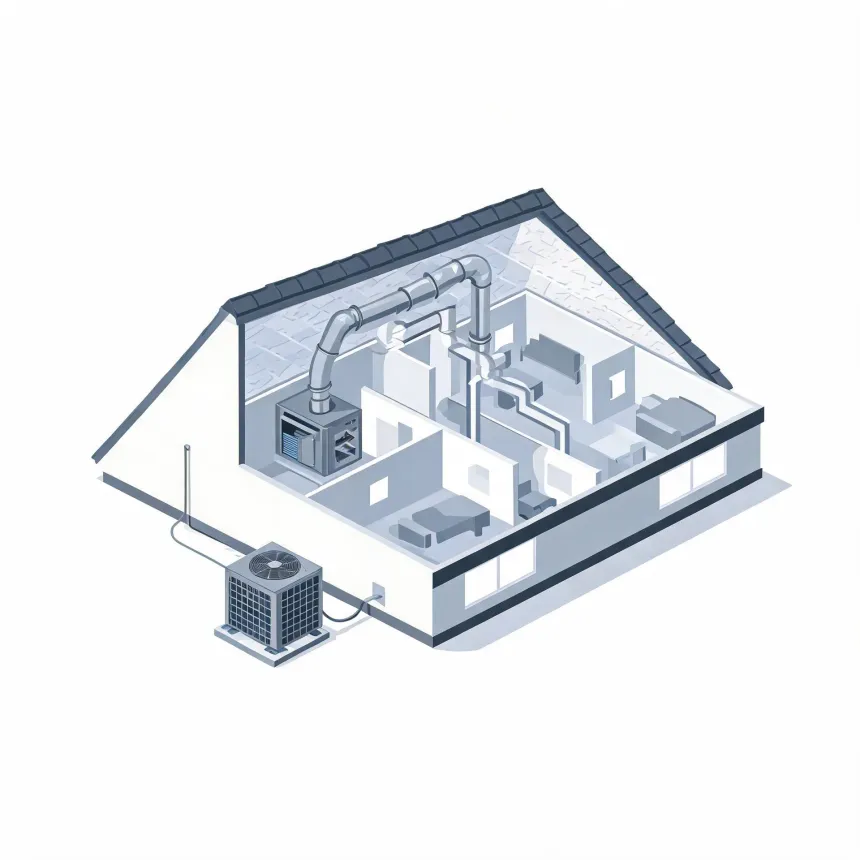
Isometric illustration of a cutaway house showing interior rooms, an attic furnace with large ducts, and an outdoor condenser unit connected by a line set, on a white background.
Your air conditioner works hardest from July through August.

NOAA nClimDiv, 1991–2020 normals

Winter storms have hit Latah County 251 times between 2015 and 2024.

None of that changes how an AC gets sized. Match it to the home, not the weather.

A system that doesn't have much to prove

Summer afternoons average 79°F
25 damaging wind events from 2015 to 2024
Power costs 11.52 cents a kWh statewide
Electricity here runs 11.52 cents a kilowatt-hourBelow the national average, so a standard-efficiency system is a fair place to start.

Latah County falls under zone 5B, a cool zone where heating carries most of the load. That doesn't loosen what's required on the cooling side. Any split-system AC under 45,000 Btu/h has to meet a federal minimum of 13.4 SEER2. That floor applies here the same as anywhere else. It narrows what a contractor can put in. A unit that doesn't clear that number isn't on the table, no matter the price.

Pick the system that fits, not the one that proves the most

Afternoons here average 79°F in summer, and plenty of days won't call for the AC at all. A straightforward system sized to your home will keep up fine. Put the money into a unit that matches your ductwork and power supply instead of one built for heavier climates.

Find a contractor
An outdoor residential air conditioning condenser unit mounted on a concrete pad, surrounded by gravel with a blue sky in the background.

Running longer isn't the problem. Running wrong is.

An oversized AC cools the air fast and shuts off before it pulls the moisture out of it. The room hits the thermostat's number but still feels damp. Do that cycle after cycle and the house never feels right, no matter how often the system runs. Undersized is its own problem. It runs long and still can't catch up on the hottest afternoons, and the compressor never gets a break. Getting the size right isn't a guess. A contractor measures the house itself. Square footage, windows and which way they face, how much insulation is in the attic and walls, the layout of the rooms. That load calculation is what tells you the right output for this specific house, not the one next door with a similar floor plan but a different roof or more shade. Homes that look alike from the street can still need different systems.

The number is a ratio, not a guarantee

SEER2 compares the cooling a system puts out against the electricity it takes to do it over a season, tested under set conditions. A higher number means it can do more with less power. It doesn't account for a duct system that leaks air before it reaches the room, or a unit sized wrong for the house it's in. The rating describes the equipment, not the install.

What eats the rating back out

A correctly sized system run through tight ducts gets close to what the label promises. Leaky ducts, a clogged filter, or a refrigerant charge that's off all pull real-world performance below the rated number, no matter how high it is. The label is the ceiling. What a contractor sets up around the unit decides how close you get to it.

Aerial view of a gray outdoor air conditioning condenser unit mounted on a concrete pad next to a house with vinyl siding.

Going above the federal minimum saves little here, about $10 a year.

  • A higher-efficiency unit$50 a year
  • A new unit at the federal minimum, 13.4 SEER2$60 a year

Estimates for a typical Latah County home, from EIA household energy data, Idaho fuel prices and NOAA climate normals. Your home will differ.

Installation day starts with the old system coming out, if there is one, and the new unit getting set in place, outdoor condenser on its pad, indoor coil matched to the furnace or air handler. Refrigerant lines get run or replaced, and the electrical hookup gets tied in to match the new unit's draw. Once it's connected, a contractor pulls a vacuum on the line set to clear out air and moisture before any refrigerant goes in. Skip that step and moisture sits in the lines, and it causes problems months later, not on day one. Charging the system comes next, weighing in refrigerant to the amount the manufacturer specifies for that line length. After that, the system gets run through its paces, checking airflow at the vents, checking that the thermostat is actually calling for cooling and getting it. A straightforward swap, same location, same ductwork, usually wraps in a day. Anything that involves new ductwork or an electrical panel upgrade takes longer, since that work has to happen before the unit itself goes in.