Two months of real heat
Homes here run the AC about two months a year, July and August, with afternoon highs averaging 83°F. That's a short stretch for a compressor to work hard.
Takes about a minute. No obligation.
Homes here run the AC about two months a year, July and August, with afternoon highs averaging 83°F. That's a short stretch for a compressor to work hard.
An AC that only pushes through two hot months usually isn't worn out from the work. When one breaks down here, age or a neglected part is the more likely cause, and that's often worth repairing rather than replacing.
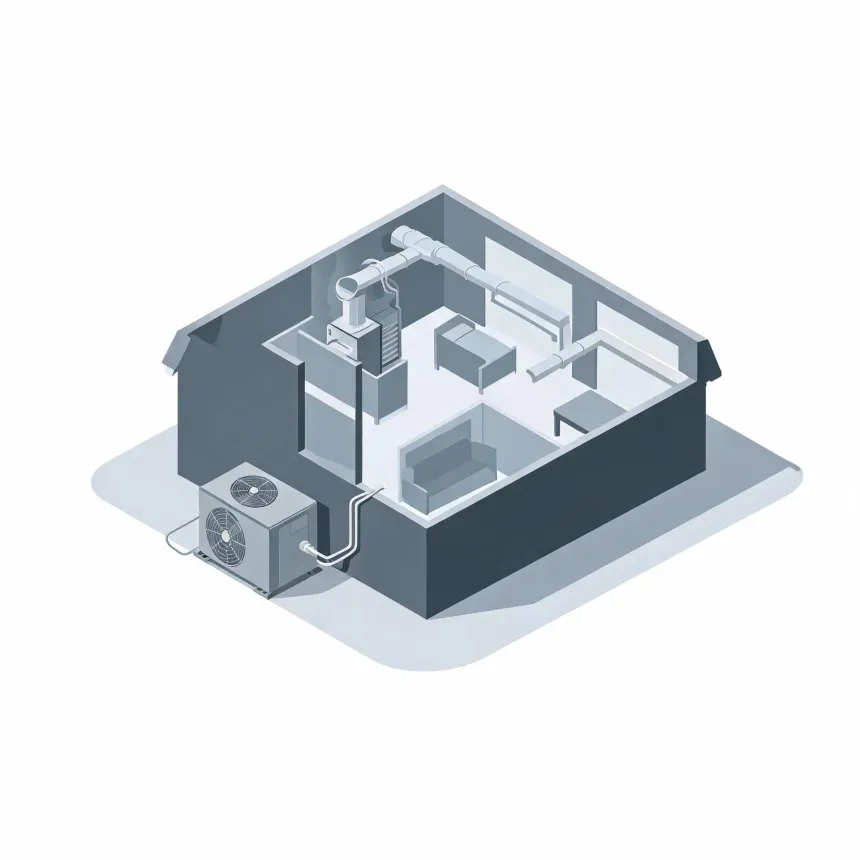
NOAA nClimDiv, 1991–2020 normals
A failing compressor usually keeps running weak before it quits outright.
A compressor caught weak can often be repaired, but one that seizes has to be replaced.



A weak capacitor won't stop your AC. It just makes the compressor struggle every time it tries to start. Leave that alone long enough and the compressor itself takes the damage. A refrigerant leak works the same way. The system keeps running low on charge, but the compressor has to work harder to make up for it, and that strain is what wears it out early. A dirty condenser coil follows the same pattern. Restricted airflow forces the compressor against higher pressure than it was built for, every cycle. None of this looks like a breakdown while it's happening. The air keeps blowing, so it's easy to assume the system is fine, right up until the part that was struggling finally quits.
It has an easier job here than in most places, so your air conditioner is often in decent shape. Repair is usually worth it.
Find a contractorMost AC failures start small. A capacitor loses its charge slowly, so the compressor starts a little weaker each time. Nobody notices until it doesn't start at all. A contactor pits and burns a little every time it closes, from normal arcing, until one day it doesn't make contact. Fan motor bearings dry out over time. The motor runs hotter and slower, and that's usually the point someone notices. Even a clogged condensate line works this way. No one thinks about it until the system shuts itself off on a float switch, or water shows up where it shouldn't. The part people worry about is the compressor. The part that actually gives out first is usually whatever was supposed to protect it.
Check the thermostat is set to cool and the temperature is actually below room temperature. Look at the outdoor unit and see if the fan is spinning. Check your breaker panel for a tripped breaker. Look at the air filter and replace it if it is gray or clogged. Check any vents in the rooms to make sure they're open and not blocked by furniture.
Don't pull the panel off the outdoor unit or touch anything inside it. The capacitor in there can hold a charge even with the power off. Don't add refrigerant yourself or try to find a leak. If the outdoor unit is humming but the fan isn't turning, or you smell something burnt near the indoor unit, turn the system off at the thermostat and wait for a licensed contractor.
Estimates for a typical Owyhee County home, compared with an older unit built to the previous federal minimum, from EIA household energy data, Idaho fuel prices and NOAA climate normals. Your home will differ.
Repair makes sense when a part like a capacitor or contactor has failed.
Replacement makes sense when the compressor has failed or the system uses R-22 refrigerant, which is no longer made.
A contractor starts with the capacitor and contactor, since those fail most often and take only a minute to test. Next come refrigerant readings, taken with gauges on the service ports. That shows whether the system is low, and whether a leak caused it or the charge just settled over the years. Airflow gets checked too. A dirty coil or a clogged filter can choke the system in a way that looks like a refrigerant problem even when the charge is fine. Electrical readings come last, confirming the compressor is pulling the current it should instead of straining to start. Most of this happens at the outdoor unit, before anyone touches a panel inside the house.