Summers here don't push an AC hard
Afternoon highs in Kamiah average 78°F in June, July and August. That's mild work for an air conditioner compared to most places it runs.
Takes about a minute. No obligation.
Afternoon highs in Kamiah average 78°F in June, July and August. That's mild work for an air conditioner compared to most places it runs.
Without years of heavy summer load wearing it down, a unit that's acting up is more likely dealing with a worn part or something that got missed than a system worn out from overuse. That's worth knowing before deciding whether a repair makes sense.

NOAA nClimDiv, 1991–2020 normals
Warm air from the vents with the thermostat set low points to a refrigerant or compressor problem, not a thermostat setting.
A short cycle, where the unit shuts off a few minutes after starting, usually means a sensor or electrical fault that will not fix itself.




Before paying for a repair, it's worth finding out how old the unit actually is. If your AC came with the house and nobody's touched it since, age may be part of what's going on now, especially if it's acting up in more than one way. A contractor can check the nameplate and tell you where it stands. That's a quick thing to ask for during the same visit, before deciding whether to fix this one or plan for a new one.
It has an easier job here than in most places, so your air conditioner is often in decent shape. Repair is usually worth it.
Find a contractor
Before anyone comes out, check the filter. A clogged filter starves the system of airflow and can cause the coil to ice up, which looks like a refrigerant problem but isn't. Pull it out and hold it up to a light. If you can't see through it, replace it. Next, look at the outdoor unit. Leaves, grass clippings and dirt packed against the fins block airflow the same way a dirty filter does, so clear anything stacked against it. Check that the thermostat is set to cool and the temperature is actually below room temperature, and swap the batteries if the display looks dim or blank. Look at the circuit breaker panel for a tripped breaker. If the outdoor unit is silent and the indoor fan won't run either, that's worth ruling out before assuming the worst. If the system runs but the air isn't cold, or it short cycles no matter what you check, that's past what you can fix from the outside.
Once ice builds on the coil, airflow gets worse the longer the system runs, so more ice forms and the compressor keeps working against a block of ice instead of cooling your home. Running it longer to try to catch up only adds to the ice. Shutting it off and letting the coil thaw fully is what actually stops the cycle.
A compressor that's struggling, from low refrigerant or an electrical fault, draws more current than it should. Keep calling on it and the extra heat and strain push it closer to a full seizure. Shutting the system down when something sounds or feels wrong protects the part that's hardest to replace.
Estimates for a typical Lewis County home, compared with an older unit built to the previous federal minimum, from EIA household energy data, Idaho fuel prices and NOAA climate normals. Your home will differ.
Repair makes sense when a part like a capacitor or contactor has failed.
Replacement makes sense when the compressor has failed or the system uses R-22 refrigerant, which is no longer made.
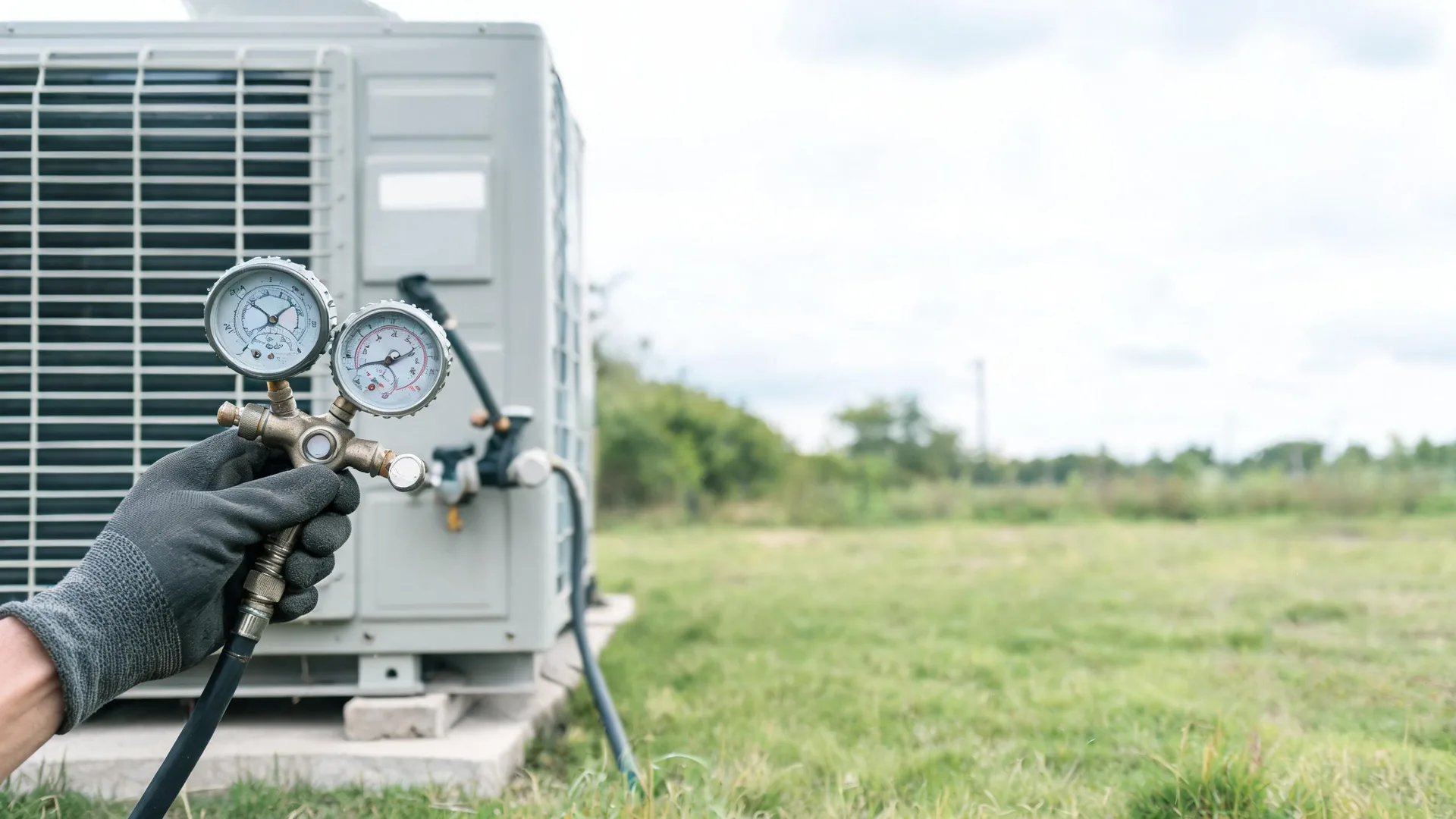
A diagnostic starts outside at the unit itself. The contractor hooks gauges to the service ports and checks refrigerant pressure. That number points straight to a leak, a bad valve or a failing compressor. Next comes the electrical side. Capacitors, contactors and wiring get tested, because a weak capacitor can make a compressor struggle to start even when everything else is fine. Indoors, they check airflow across the coil and the temperature of the air going in against the air coming out. That split tells them whether the system is actually cooling or just moving air around. Only after all of that do they land on what's actually wrong, rather than guessing from what the thermostat shows.