





Illuminated stone-and-timber mountain homes line a quiet street at dusk, with evergreen trees and a mountain range in the background.

AC Repair in Victor, ID

Tell us about the job

Takes about a minute. No obligation.

RepairCentral ACTeton County, ID
Step 1 of 2

What ZIP code is the job in?

Summers around Victor don't ask much of an air conditioner. The afternoon high averages 75 degrees across June, July and August, and some years don't give it a real reason to run at all. A unit that never has to fight real heat doesn't wear the way one does further south. So when your AC is acting up, it's rarely because the machine has been worked hard. More often it's a part that's aged out or something that got skipped along the way. That usually makes it worth repairing rather than replacing.

75°F
the average summer afternoon it cools against
1 hail events
in ten years, and hail bends the fins on outdoor coils
45 wind events
in ten years, and wind drives debris into outdoor units
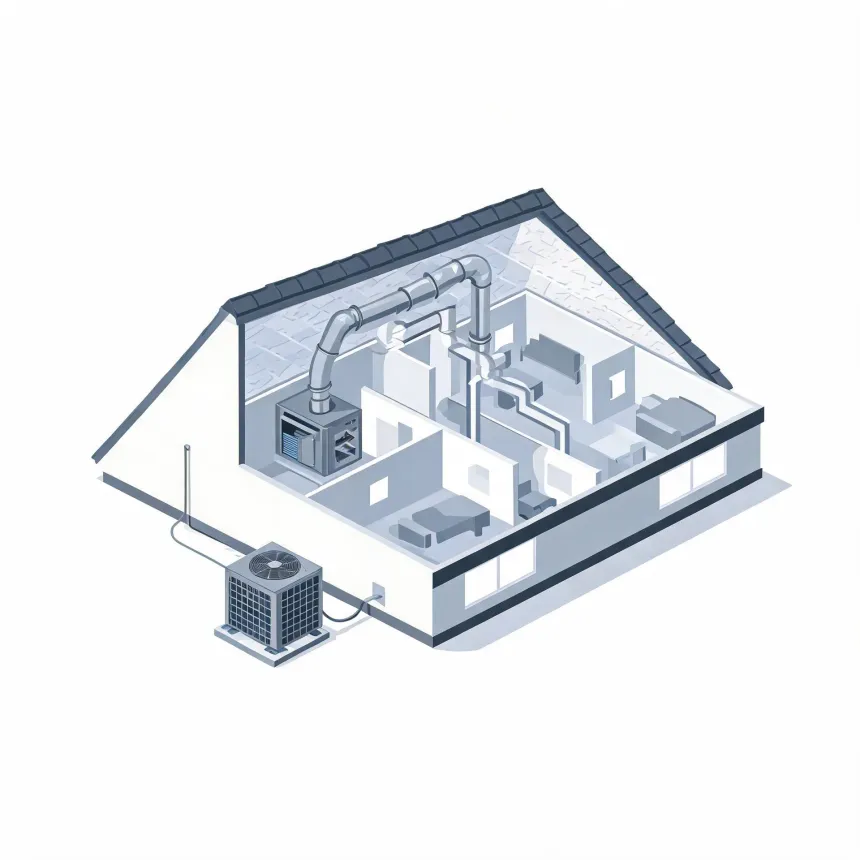
Isometric illustration of a cutaway house showing interior rooms, an attic furnace with large ducts, and an outdoor condenser unit connected by a line set, on a white background.
Your air conditioner works hardest from July through August.

NOAA nClimDiv, 1991–2020 normals

Check the thermostat batteries and the breaker before anything else.

If the outdoor unit won't come on at all, that's often the whole problem.

Half the homes here were built in 2001 or later, and the AC is often that age too

Half the homes here were built by 2001
Climate zone 6B
Power costs 11.52 cents a kWh statewide

It's usually worth repairing

It has an easier job here than in most places, so your air conditioner is often in decent shape. Repair is usually worth it.

Find a contractor
A man in a dark cap, dark T-shirt and brown work pants, seen from behind, carries a canvas tool bag up concrete steps toward a green front door.
An outdoor residential air conditioning condenser unit mounted on a concrete pad, surrounded by gravel with a blue sky in the background.

Running it longer rarely helps

A struggling system rarely fixes itself by running longer. If the compressor is low on refrigerant, every extra hour it runs is an hour the compressor works harder than it should, and that shortens its life. If a capacitor is weak, it has to push the compressor and fan motor through a harder start each cycle until one of them fails to start at all. Even something as simple as a dirty filter restricts airflow, and the system responds by running longer to try to catch up, which only adds more strain. Ice on the coil is the clearest case. Once a coil starts icing, the airflow across it drops, which lets more ice form, and running the system in that state doesn't melt the ice, it just makes it worse. The same goes for a struggling fan motor. A motor that's starting to go can seize up entirely if it's left running instead of looked at. None of this means every noise or short cycle is an emergency. But a system that's clearly struggling, icing, tripping its breaker, or making a new sound, is better shut off until someone looks at it than left running on the idea that it'll work itself out.

A capacitor fails without much warning

The capacitor stores the charge that kicks the compressor and fan motor into motion. It weakens slowly, so the unit can run fine for a long stretch and then one day the fan just hums or doesn't turn at all. A tech can test it in minutes, and swapping it is a quick job rather than a sign of bigger trouble.


Refrigerant doesn't run out, it leaks

An AC doesn't use up refrigerant the way a car uses gas. If the level is low, something let it out, usually a small leak at a fitting or in the coil itself. Adding refrigerant without finding and fixing that leak just means doing it again later, so the leak is the actual repair.

An outdoor air conditioning condenser unit positioned on a concrete pad next to a blue-sided house, surrounded by green shrubs and flowering hydrangeas at sunset.

A new air conditioner would save little on running costs in Teton County, so the repair decision comes down to the unit's condition.

  • A new one at the federal minimum, 13.4 SEER2$20 a year
  • An older air conditioner$30 a year

Estimates for a typical Teton County home, compared with an older unit built to the previous federal minimum, from EIA household energy data, Idaho fuel prices and NOAA climate normals. Your home will differ.

Repair makes sense when a part like a capacitor or contactor has failed.

Replacement makes sense when the compressor has failed or the system uses R-22 refrigerant, which is no longer made.

A compressor is the one part that changes the math. It's the most expensive thing in the unit, and if it fails outright, a tech will usually walk you through replacing the whole system instead of just that part. Everything else, the capacitor, the fan motor, the contactor, the control board, is a normal repair with no real argument for replacing the unit over it. Age on its own doesn't fail anything. What matters is which part has actually gone bad, and whether that part can be swapped on its own or not.