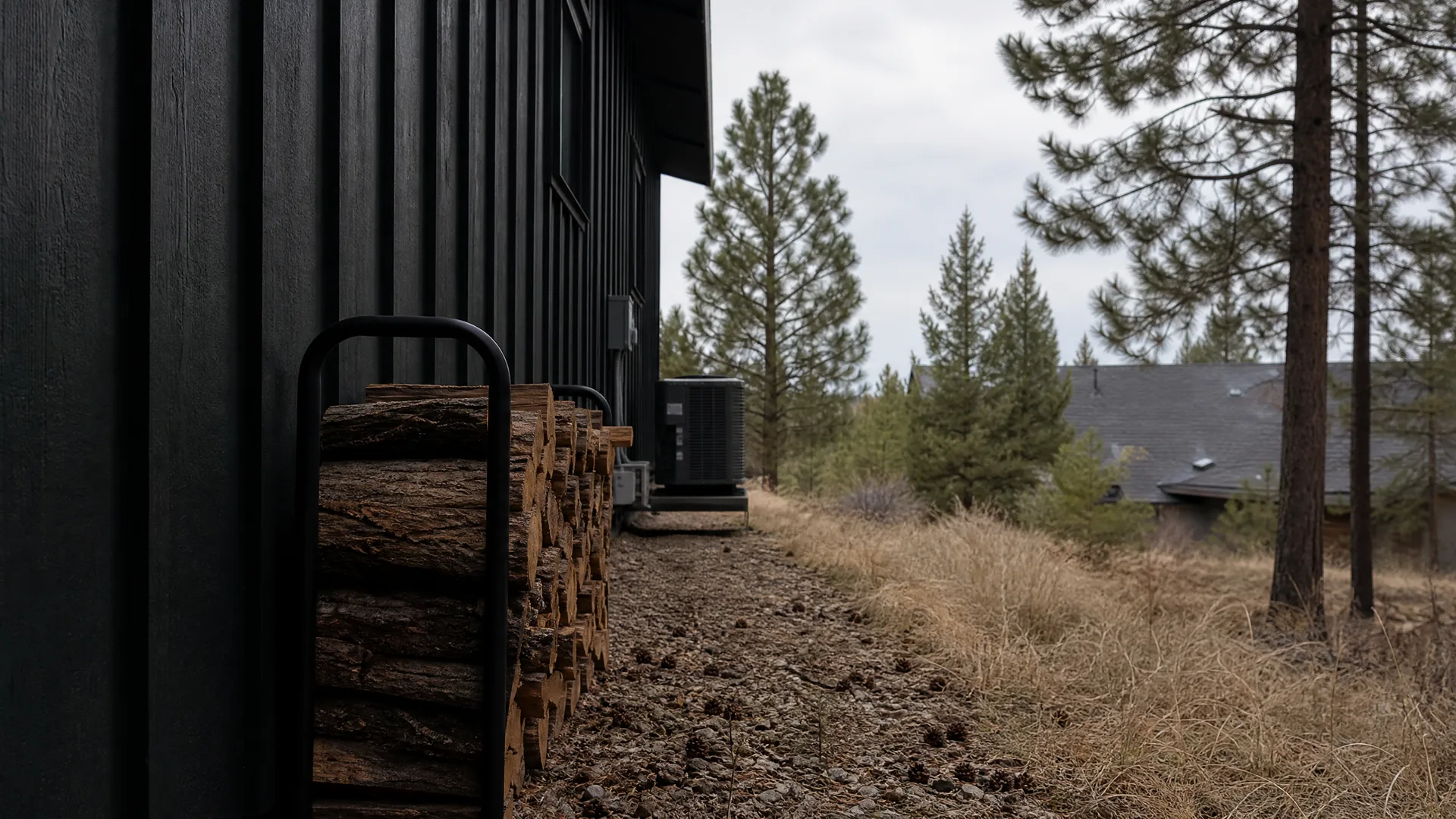
A black vertical-board exterior wall with a metal rack of stacked firewood, an air-conditioning condenser unit beyond, and dry grass, gravel and pine trees with a neighboring roof in the background.

Heat Pump Repair in Coeur d'Alene, ID

Tell us about the job

Takes about a minute. No obligation.

RepairHeat PumpKootenai County, ID
Step 1 of 2

What ZIP code is the job in?

The tech checks the whole system, not just the symptom

A heat pump that blows warm air when it should be cooling, or won't switch over for winter, can trace back to the reversing valve, the thermostat, the refrigerant charge or the outdoor coil. The tech runs the system in both modes, checks pressures and temperatures, and looks at the compressor and fan before settling on a cause.


What gets found decides what happens next

A stuck reversing valve or a failed capacitor is a straightforward repair on the spot. A refrigerant leak means finding where it's escaping before anything gets added back. A compressor that's failing is a different conversation, since it drives the whole system and sits at the center of how the unit runs.

10 months
September through June, your system heats
1 months
July through July, it cools
25°F
the average winter night it heats against
77°F
the average summer afternoon it cools against
Isometric illustration of a cutaway house showing interior rooms, ceiling ductwork and an air handler, connected by lines to an outdoor condenser unit on a pad beside the building.
Your system heats September through June and cools July through July.

NOAA nClimDiv, 1991–2020 normals

Kootenai County winters hold a 25°F average overnight low, and the heat pump isn't fighting extreme heat come summer either.

A heat pump working a milder range all year tends to hold up well, so a repair here is often the right call.

June and August are when this heat pump earns its keep

Cooling runs July through July
Heat runs September through June
68 damaging wind events from 2015 to 2024
Coeur d'Alene Heat Pump RepairIdaho homes paid 11.52 cents per kilowatthour in 2024, and a heat pump running a mild range is cheap to keep fixing.

A reversing valve fails from the inside out. It's built to slide back and forth every time the system switches between heating and cooling, and over years that movement wears the seal until it sticks halfway or stops moving at all. The outdoor coil fails differently, from the outside. It sits exposed to weather and debris, and a coil caked with dirt or bent fins can't transfer heat the way it needs to, which drags down the whole system's output. Capacitors just wear out with age and heat cycling, no outside cause needed. A refrigerant leak is its own category, since the system doesn't consume refrigerant the way it burns fuel. If the charge is low, it's low because it's leaking out somewhere, and that somewhere has to be found before anything gets refilled.

Half the homes here were built in 1996 or later

Half the homes in Kootenai County were built in 1996 or later. If your heat pump came with a house that age, it likely still has years of working life in it, and that makes fixing what's wrong the right first move.

Find a contractor
A gray outdoor HVAC unit mounted on a concrete pad beside a house with gray lap siding and a stone foundation.

What to check before the tech shows up

A heat pump doesn't give much warning before it needs a tech, but there are a few things worth checking first. Look at the outdoor unit and clear away any leaves, grass clippings or ice built up around the coil, since airflow problems there can look like a lot of other failures. Check the thermostat batteries and settings, since a thermostat stuck in the wrong mode can mimic a reversing valve problem. Check the air filter, because a clogged one starves the system no matter what else is working right. Look at the circuit breaker, since a tripped breaker shuts the whole unit down with no other symptom at all. None of this fixes a stuck reversing valve or a refrigerant leak, but it rules out the easy explanations before anyone comes out.

A frozen coil keeps freezing

A heat pump low on refrigerant or starved for airflow forms ice on the outdoor coil. That ice blocks the airflow further, so more ice forms, and the system loses capacity the longer it runs. Left alone it ends up pushing liquid refrigerant back to the compressor, which is what actually kills compressors.

A struggling system still runs

When a heat pump can't reach the temperature set on the thermostat, it doesn't stop, it just keeps running. Auxiliary heat strips or a backup system may kick in to cover the gap, and the unit never cycles off long enough to show anyone how badly it's actually working.

Most calls start with something simple the homeowner noticed, not a diagnosis. The system runs but the air coming out doesn't feel right, warm in cooling mode or cool when it should be heating. Short cycling is another one, where the unit kicks on and off every few minutes instead of running a full cycle. Ice on the outdoor unit that doesn't melt off between cycles is worth a call on its own. So is a hissing or bubbling sound near the lines, which usually means refrigerant escaping somewhere it shouldn't. A compressor that hums but won't start, or a unit that trips its breaker more than once, has moved past anything a homeowner can check themselves.

A compressor is the one part that decides the whole question. Reversing valves, capacitors, even coils can be replaced on their own without touching the rest of the system. A compressor sits at the center of it, and when it starts failing, a tech has to weigh its age and condition against the cost of swapping the whole outdoor unit. A compressor that's grounded out or seized isn't getting repaired at all, only replaced. One that runs but sounds wrong, or trips on overload repeatedly, might have a few years left or might not, and that's a judgment call made after testing it, not before. This is usually the point where a tech stops talking about parts and starts talking about the unit as a whole.