






A gravel road lined with a rustic log fence on the left and a row of dark-clad gabled cabins with metal roofs on the right, surrounded by pine forest.

Mini Split Installation in Council, ID

Tell us about the job

Takes about a minute. No obligation.

New system or replacementMini-splitAdams County, ID
Step 1 of 2

What ZIP code is the job in?

Cooling runs one month a year here, July, and even then afternoons average 78°F. That is not heat that pushes a mini split hard. A system sized for this place does not need to be built for a long, hard summer, because there isn't one. The case for spending up on the highest efficiency model gets weaker when the unit only has to work like this. A mid-range mini split, sized right and installed well, will handle July here without strain.

10 months
September through June, your system heats
1 months
July through July, it cools
19°F
the average winter night it heats against
78°F
the average summer afternoon it cools against
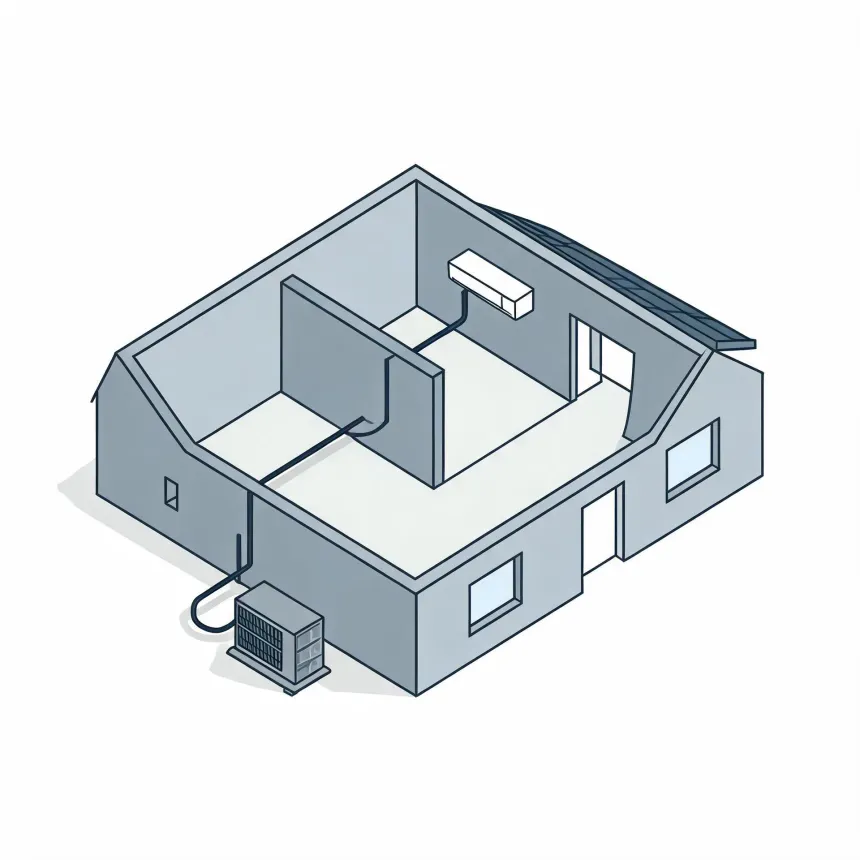
Isometric line illustration of a cutaway house showing an interior wall-mounted air conditioning unit connected by a line to an outdoor condenser beside the exterior wall.
Your system heats September through June and cools July through July.

NOAA nClimDiv, 1991–2020 normals

Cooling in Adams County runs one month a year, July.

Get the mini split installed by June and it's ready before that month starts.

Power here runs 11.52 cents a kilowatt-hour, so the highest-efficiency model earns its keep slower

Power costs 11.52 cents a kWh statewide
Cooling runs July through July
Summer afternoons average 78°F
Put the money into the install, not the SEER numberAt 11.52 cents a kilowatt-hour, a mid-range mini split installed right will cost less to own than a high-efficiency one installed loose.

The cost of a mini split job comes down to what the installer has to do to get refrigerant line from the outdoor unit to the indoor head, and how many heads the system needs to run. A single zone system with a short line run is the simplest case. Add a second or third zone, or route line through a long wall or up through tight framing, and the labor grows even though the equipment list barely changes. Where the outdoor unit sits matters too, since a longer line set and more refrigerant to charge add work the homeowner never sees on the wall. Electrical is its own piece. A mini split needs a dedicated circuit, and whether the panel already has room for one changes the job before any equipment gets mounted. None of this shows up in a quote that only lists the brand and size of the unit.

Size it for a mild July, not a hard summer

Pick a mid-range mini split, sized for this place, and get it installed before July. Nothing about the job calls for the highest-efficiency unit on the lot.

Find a contractor
A man in a dark cap, dark long-sleeved shirt and brown work pants walks up porch steps toward a pale green front door, carrying a worn canvas tool bag in his right hand, with a potted evergreen shrub beside the entry.
A white outdoor air conditioner condenser unit mounted on metal wall brackets against gray horizontal siding, with a blue sky and white clouds behind it.

Sized for the room, not guessed at

Sizing a mini split is not about matching the biggest number on the spec sheet to the room. An oversized unit cools the air fast, shuts off, then starts again a few minutes later. That short cycling never lets it run long enough to pull moisture out of the air, so the room feels cold and damp instead of just comfortable. An undersized unit runs constantly, struggles to hold the temperature on the hottest afternoons, and wears out sooner for the work it's doing. The right size comes from a load calculation that looks at the square footage, the windows, the insulation and the orientation of the room, not a rule of thumb based on floor space alone. A unit sized this way cycles on, satisfies the room, and shuts off, which is exactly how it's supposed to run across its whole life.

What comes out of the wall

If a window unit or an old wall furnace is coming out, that's a straightforward pull. A ducted system is different. The old ductwork usually stays in place even after a mini split goes in, since pulling it out means opening walls and ceilings for no real gain. The furnace or air handler it was tied to either gets disconnected or removed, depending on whether anything else in the house still depends on it.

What a mini split doesn't replace

A mini split handles the room it's installed in. It doesn't take over whole-house jobs like running bathroom exhaust or a central humidifier if the old system was doing that. Anything the old equipment was quietly handling beyond heating and cooling the air needs its own answer once that equipment is gone.

The number on a mini split's label is a ratio, not a guarantee. It compares the cooling or heating the unit puts out against the power it draws, measured under set lab conditions. Run the unit somewhere milder than that test and it can do better than the label. Run it somewhere harsher and it falls short. That's why homes with the same rated unit can see different results on their power bill. The rating tells you how the equipment was built, not how your afternoons actually go. Installation changes the real number more than the label ever will. A unit with a high rating but a poorly sealed line set or a bad refrigerant charge will not hit that rating in practice. A mid-range unit installed tight, with the right charge and good airflow across the coil, often closes most of the gap against a higher-rated unit that was installed loose.

Installation day starts with the outdoor unit. The installer mounts it on a pad or wall bracket, somewhere with clear airflow on all sides, then runs the line set from there to the indoor head. That line gets routed through a wall, and the hole gets sealed once the lines are through. Inside, the head mounts to a bracket high on the wall, then connects to the line set, the condensate drain and the electrical whip. Once everything's connected, the installer pulls a vacuum on the line set. That clears out moisture and air before the refrigerant ever moves. The charge gets checked against what the unit calls for, then the installer runs it through a cooling cycle, checks the temperature at the head, and confirms the condensate drains where it should instead of backing up into the wall.