Gas heats most homes here
Utility gas heats 56% of occupied homes in Bonneville County, with electricity a distant second at 37.8%. A furnace is still the default here, not a heat pump.
Takes about a minute. No obligation.
Utility gas heats 56% of occupied homes in Bonneville County, with electricity a distant second at 37.8%. A furnace is still the default here, not a heat pump.
Most homes here keep their gas furnace for the cold months and add a mini split for the rooms that need their own heating and cooling, or for cooling a house that never had AC.
Summer afternoons in Bonneville County average 77°F.
A mini split here mostly handles mild afternoons, not real heat.



Idaho Falls runs on some of the cheaper electricity in the country, 11.52 cents per kilowatthour. That changes the math on which mini split to buy. A higher-efficiency model costs more up front, and here it takes longer to earn that back in lower bills. So picking the most efficient unit on the shelf isn't the priority it would be somewhere with expensive power. What matters more is whether the system is sized right for the room and holds up through winter. A contractor can help weigh efficiency against upfront cost for your situation.
Bonneville County sits in climate zone 6B. Any mini split installed here has to meet the federal minimum for a split-system heat pump. That floor is 14.3 SEER2 for cooling and 7.5 HSPF2 for heating. There's no separate rule for ductless systems, they fall under the same standard. A federal tax credit is available toward a system that qualifies.
Find a contractor
With no real cooling load, a mini split here isn't working to keep up on the hottest days the way it would somewhere further south. That's less wear on the compressor over the life of the system. What shortens a mini split's life here is more likely to be a bad install or years without a filter cleaning than the weather asking too much of it. So the system doesn't need to be the strongest one on the shelf, it needs to be sized right for the room and put in correctly.
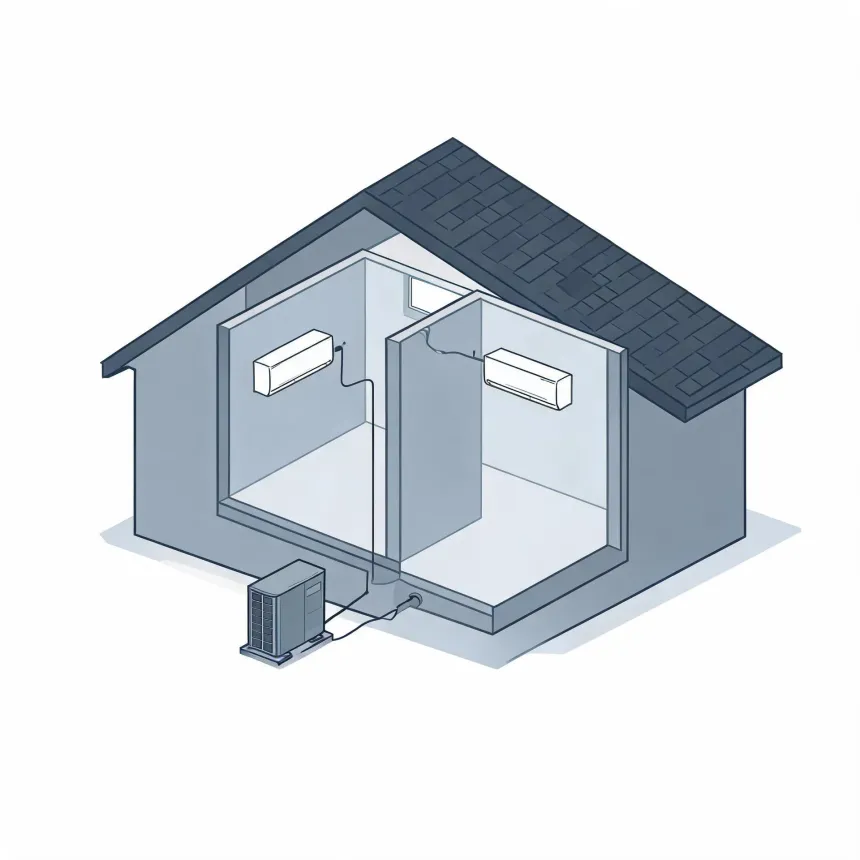
The indoor head and the outdoor unit need a refrigerant line, a drain line and a power line connecting them. A short straight shot through an exterior wall is quick work. Running lines through a finished ceiling, up multiple floors or across a long distance between the head and where the outdoor unit can sit takes more time and more material, and that shows up in the price.
A single room needs one indoor head and a small outdoor unit to match it. Cover several rooms and you're either running a multi-zone system off one larger outdoor unit, or installing separate systems. Each additional zone adds its own line set, its own mounting work and its own controls, so the cost scales with how many rooms you're actually conditioning, not just the square footage.
When you're comparing quotes, ask how many zones the outdoor unit can actually run and whether it's sized to the rooms you want conditioned, not just the total square footage. A unit sized for one large room won't perform the same once it's split across several smaller ones. Ask where the outdoor unit will sit and how the line set gets from there to each indoor head, since that path is most of what separates one bid from another. Ask what happens if a zone gets added later, because some outdoor units have capacity for it and some don't. And ask who services the brand locally. A mini split that needs a part shipped in when the compressor trips is a different ownership experience than one a nearby contractor already stocks.
SEER2 tells you how much cooling or heating a unit squeezes out of the electricity it draws, under set test conditions. A higher number means less power for the same result. It isn't a measure of how big a system is or how fast a room cools. Mini splits with the same SEER2 rating can still feel different in daily use, because install quality and sizing matter as much as the number on the sticker. HSPF2 is the same idea for heating mode. A high rating on a unit that's too big or too small for the room won't deliver what the label promises, since the rating assumes the system is matched to the space it's cooling or heating.