





A white wall-mounted split-system air conditioner on a blue-grey wall, with a full moon visible through a curtained window at night.

Mini Split Installation in Jerome, ID

Tell us about the job

Takes about a minute. No obligation.

New system or replacementMini-splitJerome County, ID
Step 1 of 2

What ZIP code is the job in?

Close to half the homes in Jerome County heat with electricity, and about a third use utility gas. If your house already runs on electric heat, a mini split fits right into that setup without asking for a gas line or ductwork it doesn't have. It handles cooling too, so one system covers both jobs through the summer and winter. For homes on gas furnaces, a mini split still works well as a way to add cooling or to heat a room the furnace doesn't reach.

9 months
September through May, your system heats
2 months
July through August, it cools
22°F
the average winter night it heats against
85°F
the average summer afternoon it cools against
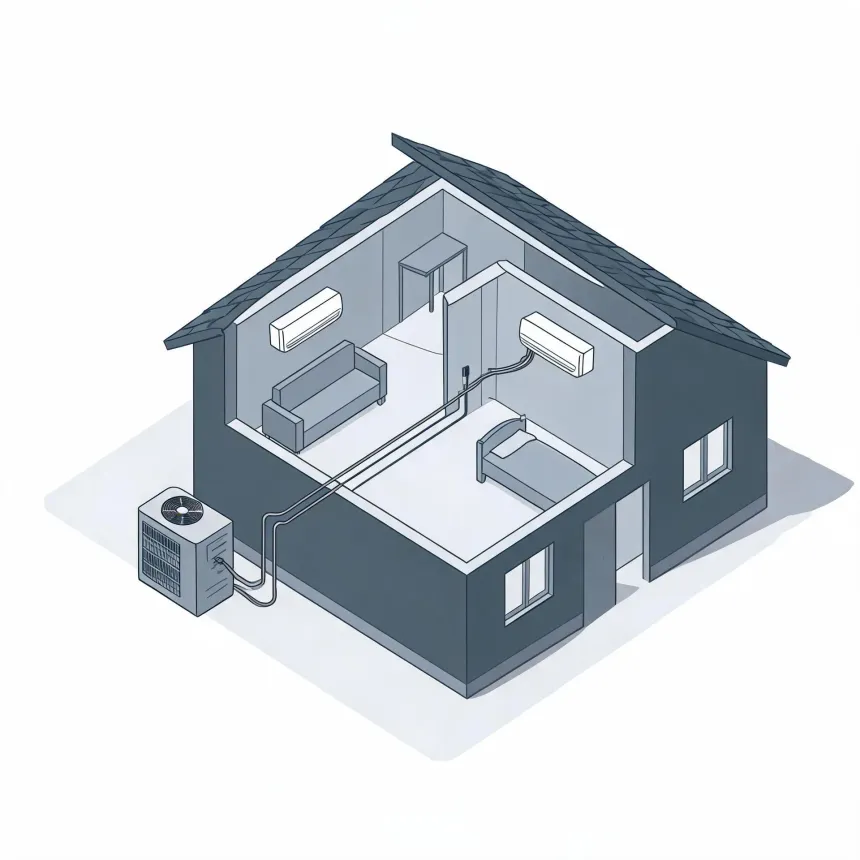
Isometric cutaway illustration of a small house showing two wall-mounted indoor air conditioning units connected by line sets to an outdoor condenser unit beside the exterior wall, with a sofa in one room and a bed in another.
Your system heats September through May and cools July through August.

NOAA nClimDiv, 1991–2020 normals

Cooling in Jerome County runs July through August.

June is the month to get a mini split installed, before the first hot week puts it to work.

Two months of real work a year

Cooling runs July through August
Summer afternoons average 85°F
Power costs 11.52 cents a kWh statewide
Cheap power hereIdaho electricity ran 11.52 cents a kilowatt-hour in 2024, among the lowest rates in the country.

A mini split quote has a few real cost drivers behind it. How many zones you're running is one, since each indoor head needs its own line set and its own spot on the outdoor unit's capacity. Where the outdoor unit can go matters too, since a longer line set run between indoor and outdoor units takes more refrigerant and more labor than a short one. The electrical panel plays into it as well, since a system needs a dedicated circuit and some panels have room for that and some need work first. Wall construction matters at the install point, since running line sets through brick or block takes more time than through wood framing. None of this shows up on a spec sheet, but it's most of what separates one quote from another for the same unit.

Pick the mini split that fits, not the one with the top efficiency number

With power this cheap, a higher-efficiency mini split takes longer to earn back its extra cost. What matters more is getting a system sized and installed right for your house. Talk to a contractor about which model fits your home, not just which one has the best rating on paper.

Find a contractor
A man in a dark cap, gray T-shirt and tan work pants walks up porch steps toward a green front door, carrying a canvas tool bag with hand tools, beside a potted shrub.
A white mini-split air conditioner outdoor condenser unit mounted on metal brackets against a beige stucco exterior wall, with a blue sky and scattered clouds in the background.

Short summers don't call for the top-shelf unit

Two months of cooling, with afternoons around 85°F, isn't much load to size against. A contractor can run a proper heat load calculation and land on a mid-tier mini split sized to your house, rather than pushing the highest SEER2 number on the shelf. That smaller spec sheet still meets the federal minimum and still qualifies for the tax credit. Put the money into getting the size and the install right instead.

What SEER2 and HSPF2 actually measure

SEER2 rates cooling efficiency over a season, HSPF2 rates heating. Both compare the energy a mini split moves against the electricity it uses to move it. A higher number means the unit gets more cooling or heating out of the same power, not that it cools or heats faster or harder.

The rating only holds if the install is right

A lab produces that number with the unit sized and installed the way it's meant to be. A mini split that's oversized, undersized, or paired with a mismatched indoor and outdoor unit won't deliver the rated efficiency no matter what the label says. Sizing the system to the house is what makes the number mean anything.

When you're comparing quotes, ask how each contractor arrived at the size they're proposing. A mini split sized off square footage alone is a guess. One sized off a room by room heat load calculation accounts for your windows, insulation, and layout, and different contractors can look at the same house and land on different numbers. Ask whether the quote is for a single zone or multiple zones, since a multi-zone system splits output across rooms and needs a different outdoor unit than a single room would. Ask what happens to the old line set and electrical if you're replacing a system, since reusing them without checking can undercut a new unit's performance. And ask who services the brand locally. A mini split is only as good as the contractor who can get parts for it and stands behind the work.

A mini split that's too big for the room cools fast and then shuts off before it pulls the moisture out of the air. The room feels cold and clammy at once, and the outdoor unit spends its life cycling on and off instead of running steady. One that's too small just runs constantly and never gets the room where you want it, working hardest on the days you need it most. Sizing isn't a single number either. A contractor works out how much heat the room gains in summer and loses in winter, based on the windows, the walls, the ceiling, and how the rooms connect, then matches that load to an indoor and outdoor unit built to deliver it. Get that step right and the system runs quiet, holds its temperature, and lasts as long as it's built to.