Gas heats most homes here
Utility gas heats 47.9% of occupied homes in Jefferson County, with electricity and propane splitting most of the rest. A mini split works alongside any of these, not against them.

Takes about a minute. No obligation.
Utility gas heats 47.9% of occupied homes in Jefferson County, with electricity and propane splitting most of the rest. A mini split works alongside any of these, not against them.
A lot of homes in Rigby already have a furnace doing the heavy heating work. That makes the mini split job about cooling and shoulder season comfort, with the existing system still carrying the coldest months.
NOAA nClimDiv, 1991–2020 normals
Idaho electricity runs 11.52 cents a kilowatt-hour, well under the national average.
A mini split still cuts shoulder season costs, but a top-tier SEER2 model takes longer to pay for itself here.




With power this cheap, a mid-tier SEER2 model is worth a look instead of reaching straight for the highest-rated unit on the shelf. The spread in monthly running cost between a mid-tier and a top-tier mini split is small when the rate per kilowatt-hour is already low. That makes the extra years it takes the premium model to pay for itself hard to justify. Put that money toward the install instead. A contractor who sizes the unit right for the room and runs the line set cleanly matters more here than squeezing out another point of efficiency. Ask what the unit costs installed, not just what it costs on paper.
Jefferson County sits in climate zone 6B. Any mini split installed here has to clear 14.3 SEER2 for cooling and 7.5 HSPF2 for heating, the federal minimum for a split-system heat pump. That floor is already built into what a contractor can sell and install here. A federal tax credit is also available for qualifying systems, worth checking before you settle on a unit.
Find a contractor
A mini split that sits idle most of the year still has to start up clean when the weather turns. Ask how the system behaves on the first warm day, not just how it runs once it's been going a while. Find out what the warranty covers on the compressor versus the smaller parts, since those tend to run on different terms. Ask about the outdoor unit's coil and how it's protected, because that's what sits exposed through the months it isn't running at all. A system that starts easy and holds its charge after a long stretch of doing nothing is worth more than one that only wins on a spec sheet.
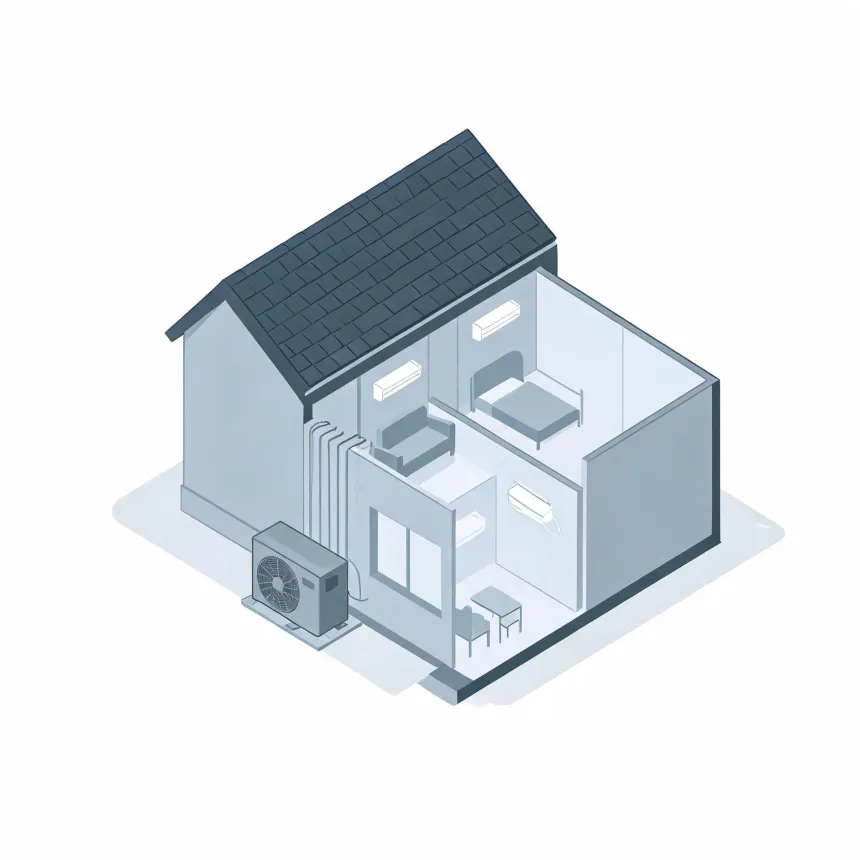
A mini split install prices out around the outdoor condenser, the indoor head, and the line set connecting them. A straight shot through an exterior wall with the outdoor unit nearby costs less than a run where the line set has to travel through an attic or along a long stretch of siding. More indoor heads off one outdoor unit raises the price too, since each zone needs its own line set and its own control.
A mini split needs a dedicated circuit, and whether that circuit already exists or has to be added changes the job. If the electrical panel has room and capacity, running a new line is straightforward. If the panel is already full, upgrading it adds real work before the mini split itself ever gets mounted.
If the old system was a window unit or a wall unit tied to the room, a contractor pulls it and patches whatever it leaves behind, the hole in the sill or the bracket marks on the siding. If the old system is a central air setup, the furnace and ductwork usually stay. A mini split doesn't need to replace them to work, it just takes over the rooms it's assigned to. The one thing worth asking the contractor directly is what happens to the refrigerant in the old unit, since it has to be recovered properly and not vented, and that's part of the job whether the old system is small or large.
Install day starts outside. The contractor mounts a bracket on the exterior wall, sets the condenser on a pad or feet, and runs the line set through a sleeve drilled at an angle so water drains out, not in. Inside, the indoor head goes up on its own bracket, usually high on a wall, with the line set, a condensate drain, and the control wiring all routed through that same small hole. The lines get connected, then the system is pulled down to a vacuum to clear out air and moisture before any refrigerant moves through it. That vacuum test matters more than almost anything else that day, since trapped moisture is what causes problems years later. Once it holds vacuum, the contractor charges the line, powers up the unit, and checks that it cools and communicates with the indoor head the way it should.