Why your house is humid with the AC on in Idaho

RepairCentral ACIdaho
Step 1 of 2

What ZIP code is the job in?

Why is my house humid in Idaho even with the AC running?

You keep the AC running and the air still feels sticky. Idaho summers are hot but dry, so a damp house doesn't match what you'd expect from the weather outside. You're the type to look into something like this before it turns into a bigger problem, and right now you want to know whether this is normal for your system or a sign something needs attention.

An oversized or short-cycling AC isn't running long enough to pull moisture out of the air

An air conditioner removes humidity by running long enough for air to pass over a cold coil. If your unit cools the house fast and shuts off, it hasn't run long enough to do that part of the job, even though the thermostat reads satisfied. This happens with a unit that's too large for the space, or one that's short-cycling because of a thermostat issue or low refrigerant. Idaho's dry outdoor air can mask the problem, since you'd expect dryness indoors to match it. A dirty coil or a clogged filter can cause the same short runtimes. If the house feels damp right after the AC shuts off and stays that way, the system is cooling without dehumidifying, and that's worth having looked at.

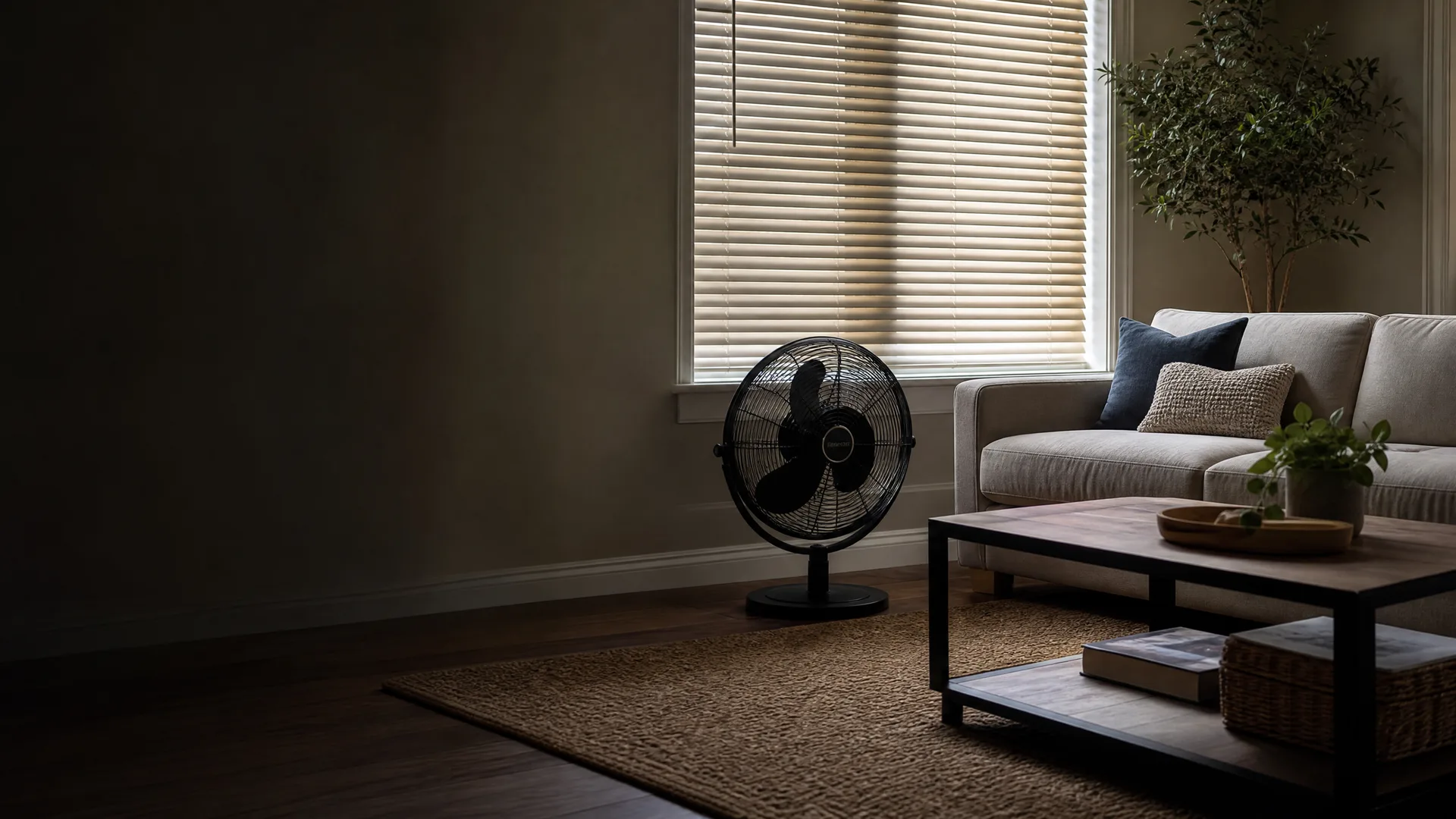
A dimly lit living room with a black table fan on the wood floor near a window with closed blinds, beside a light-colored sofa with cushions, a wooden coffee table, a woven rug, and a potted tree.

It's mid-afternoon and the sun is right on the front of the house. You've pulled the blinds shut to keep it out, and the floor fan next to the couch is running on high, pushing the air around more than cooling it. The AC is on, you can hear it, but the room still feels thick. Your shirt sticks to your back even sitting still. Outside the air is dry the way Idaho air always is in July, but in here it feels like you brought a different climate inside. You turn the fan up another notch and it doesn't help. The air just moves, it doesn't dry out.

Is this something you need to worry about

You'll notice it in small ways first. The air feels heavier than it should for Idaho. Glasses sweat on the counter. Bedsheets feel damp at night even with the thermostat set low. Wood doors and windows stick in their frames. If it goes on long enough, you'll see it on the walls and in the corners of rooms that don't get much airflow, a dusty-looking patch of mold where moisture has had somewhere to sit. None of that is normal for a house in a dry climate, and it's not something that fixes itself while the AC keeps running the same way it has been.

A gray outdoor air conditioning condenser unit on a concrete pad beside a house with horizontal gray siding, with a wall-mounted electrical disconnect box and insulated refrigerant lines, and blue hydrangeas in a mulched bed to the left.

Running the way it should

A system like this pulls humidity out as it cools, cycling long enough to do both jobs. The coil stays clean enough to pull moisture from the air, and the refrigerant charge is where it needs to be. Air comes out cold and dry, not just cold.

A gray outdoor air conditioner condenser unit on a concrete pad beside a house with beige horizontal siding, with an electrical disconnect box and insulated refrigerant lines on the wall and dry leaves on the ground.

Cooling but not drying

Years of dirt on the fins and rust on the shroud point to a unit that's lost some of its capacity. It might still bring the temperature down, but a weak charge or a dirty coil can't pull moisture out the way it used to. That's the gap between cold air and dry air.

A woman in a cream turtleneck sweater stands beside a large window with snow outside, looking to the side, in a dimly lit living room with a sofa, lamps, candles and framed artwork.
A woman in a light gray cable-knit turtleneck sweater stands by a window looking outside at snow, with a living room behind her containing a stone fireplace, lit lamp, framed pictures, and a sofa with a plaid throw.
A woman in a dark gray turtleneck sweater stands by a window with snow visible outside, in a dimly lit living room with a gray sofa, lamp, framed painting, and dark-framed glass door.
A woman in a cream turtleneck sweater stands by a window looking out at falling snow and snow-covered trees, with a dimly lit living room containing a sofa, lamp and fireplace behind her.

The right pro for this job

One request and the search for a pro is handled.

No charge to send it. You decide if you hire them.

What pulling moisture actually takes

An air conditioner takes moisture out of the air by running the indoor coil cold enough and long enough for water vapor to condense on it. That water drips into a pan and drains outside. If the system cools the room fast and shuts off, the air gets cold but the coil never stays wet long enough to collect much water. A unit sized too large for the house does exactly this. It satisfies the thermostat in a few minutes and shuts down, so the house drops in temperature without actually drying out. Idaho's dry air outside makes this easy to miss, since you'd expect the inside to feel dry too.

What a low charge does instead

Refrigerant that's low changes what the coil does entirely. A coil running at the wrong pressure gets colder than it should in spots, sometimes cold enough to frost over. Once ice forms on it, the coil stops being a surface that pulls water from the air and starts being a block of ice that blocks airflow. Moisture passes right through instead of condensing out. This is also why a system low on charge can run constantly and still not cool well. It's not short cycling, it's working the whole time and losing the fight, which feels different but ends with the same sticky air.

Power costs 11.83 cents per kilowatt-hour statewide

At 11.83 cents a kilowatt-hour, running your AC longer to actually dry the air out costs less here than in most states. That's worth knowing before you shorten cycles or turn up the thermostat to save money. A tech can check why the air feels damp without you having to worry about the power bill for it.

EIA-861 2025 statewide residential average

What's Behind the Sticky Air

  • Dry Idaho air outside doesn't mean the air moving through your ducts is dry too.
  • A short cycle cools the room fast but shuts off before the coil has pulled real moisture out.
  • A dirty coil or a low refrigerant charge can keep the system from drying the air even when it cools fine.
  • Sticky doors, damp sheets, and sweating glasses point to moisture the AC isn't removing, not a broken thermostat.
  • At 11.83 cents a kilowatt-hour, letting the system run longer to dry the air costs less here than in most states.
  • A tech can check the coil, the charge, and the cycle length and tell you which one is causing it.

The AC cooling the room and the AC drying the air are two different jobs, and a system can do the first without doing the second. That's the whole answer. Idaho's dry outside air gets pulled through your ducts, run across the coil, and pushed back out, but if the coil shuts off too soon or isn't cold enough, the moisture that was in that air stays in it. The thermostat reads the temperature you set and stops the cycle once the room hits it, whether or not the coil had time to pull water out. A clean coil at the right refrigerant charge, running a full cycle, does both jobs at once: cools the air and wrings the moisture out of it. A dirty coil or a low charge can still cool a room well enough that you wouldn't guess anything was wrong, while the air coming out stays damp. That's why the signs show up where they do, sticky doors, damp sheets, glasses sweating on the counter, instead of on the thermostat display. None of it means the system is broken in an obvious way. It means something in the cycle, the coil, or the charge is off, and the fix is specific to whichever one it is. At 11.83 cents a kilowatt-hour, running the system longer to let it finish the job costs less here than in most places, so there's little reason to cut cycles short to save money. A tech who checks the coil, the charge, and how long the system runs can tell you which of those is causing it and what it takes to fix it.

A bearded man in a plaid flannel shirt stands indoors looking out a condensation-covered window at a snowy landscape, with a speckled mug on the sill and kitchen shelves behind him.
A bearded man in a navy t-shirt sits on a beige sofa, laughing while looking toward a laptop screen visible in the lower foreground, with a houseplant, shelves, and a framed picture behind him.

Matched to your air conditioner job

A house that feels sticky with the AC running usually comes down to short cycling, a dirty coil, or a refrigerant charge that's off. None of those fix themselves, and none are easy to confirm by looking at the unit. A tech can check cycle length, coil condition, and charge, then adjust what's actually causing it. Send the form and a contractor who covers your area will reach out. From there it's off your plate.

Send my request

Send it once and finding someone is no longer on you.

There's no charge for the request.