Illuminated timber-and-stone mountain cabins along a curved road at twilight, with lit trees and mountain peaks in the background.

AC Installation in Payette, ID

Tell us about the job

Takes about a minute. No obligation.

New system or replacementCentral ACPayette County, ID
Step 1 of 2

What ZIP code is the job in?

Electric heat leads here

Electricity heats 44.3% of homes in Payette County, with utility gas close behind at 38.2%. That split means a lot of homes already have the electrical capacity for central air, since the furnace or heat pump is drawing on the same panel.

What it means for your install

If your home heats with electricity, adding or replacing central air is usually a more straightforward match to the existing setup. If you're on gas or propane, the AC side still runs on electric power, so the contractor will need to check what your panel can handle regardless of how the house is heated.

3 months
June through August, your air conditioner is on duty
88°F
the average summer afternoon it cools against
3 hail events
in ten years, and hail bends the fins on outdoor coils
13.4 SEER2
the federal minimum any new unit must meet
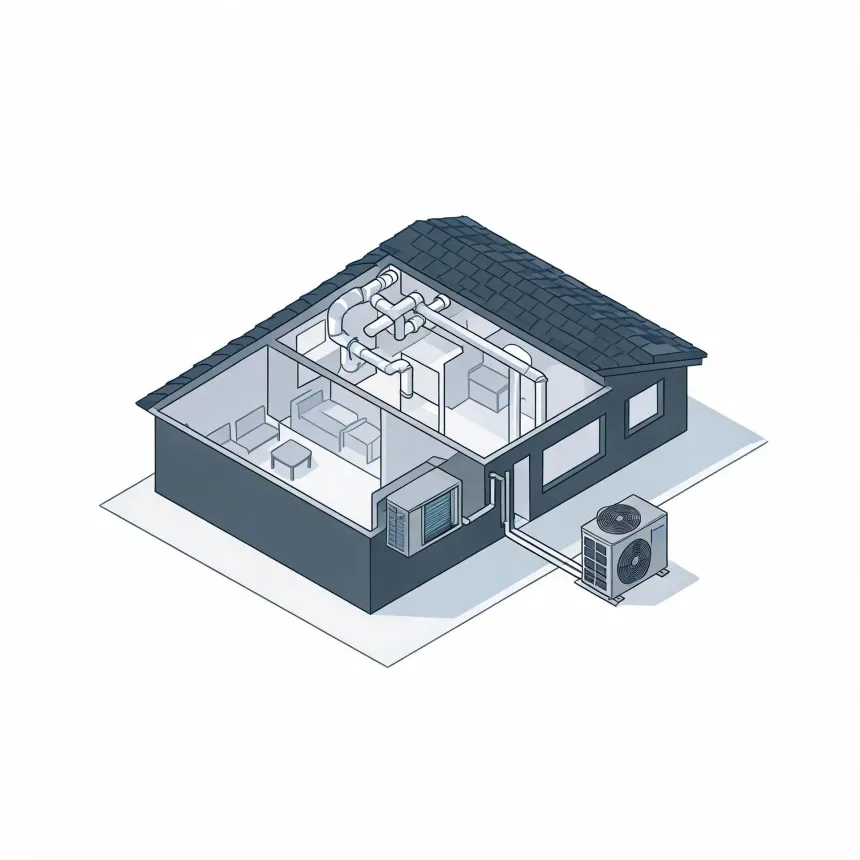
Isometric line illustration of a cutaway single-story house showing interior rooms with furniture, ceiling ductwork, an indoor air handler, and an outdoor condenser unit connected by lines along the exterior wall.
Your air conditioner works hardest from July through August.

NOAA nClimDiv, 1991–2020 normals

AC in Payette County runs from June through August.

Get a new system installed before May, so it's not your first hot week with a crew still in the yard.

A standard system fits what's here

Half the homes here were built by 1978
Climate zone 5B
Power costs 11.52 cents a kWh statewide

Payette County sits in climate zone 5B, a cool zone where heating carries more of the year's work than cooling does. Any split-system air conditioner installed here still has to meet the federal minimum of 13.4 SEER2 if it's rated below 45,000 Btu/h and built from 2023 on. That floor applies everywhere, not just here, so it's not a sign of anything unusual about Payette homes. It does mean a contractor won't be offering anything below that rating. A federal tax credit is available for qualifying high-efficiency equipment, worth checking against whatever system you're considering.

A standard-efficiency system is a reasonable choice here

Idaho electricity ran 11.52 cents per kilowatthour in 2024, well below the national average. At that rate, a high-efficiency system takes longer to earn back the difference in cost. Picking a unit that matches what the house needs matters more here than chasing the highest SEER2 number on the shelf.

Find a contractor
A gray cylindrical air conditioning condenser unit mounted on a concrete pad next to a light-colored vinyl-sided house exterior.

Three months of work a year

Three months of real work a year, and even then the afternoons average 88°F, not triple digits. That's a light load compared to what cooling systems handle in hotter parts of the country. A correctly sized system won't run close to its limit here, so the extra stages and variable-speed compressors built for long, brutal summers don't have much to prove themselves against. What wears a system out faster than anything is a bad install or a skipped filter change, not this climate. Put in a system that's sized right and maintained, and June through August here won't ask much of it.

Ask for the load calculation, not a guess

A contractor should size an air conditioner by running a room-by-room load calculation on the house, checking window area, insulation and layout. Going by the square footage of the old unit or a rule of thumb leads to a system that short-cycles or can't keep up. Ask to see the numbers, not just the final tonnage.

Ask what happens to the ductwork

A new condenser and coil only move as much air as the ducts allow. If the existing ductwork is undersized, leaky, or was built for a smaller system, the new unit will fight it. Ask whether the ducts get inspected and tested as part of the install, not just the outdoor unit swapped.

Aerial view of a gray central air conditioning condenser unit on a concrete pad next to a house with vinyl siding.

A higher-efficiency unit would save about $30 a year to run in Payette County compared with a new unit at the federal minimum.

  • A higher-efficiency unit$200 a year
  • A new unit at the federal minimum, 13.4 SEER2$230 a year

Estimates for a typical Payette County home, from EIA household energy data, Idaho fuel prices and NOAA climate normals. Your home will differ.

Install day starts with the old equipment coming out, not the new unit going in. Expect the refrigerant in the old system recovered, the condenser disconnected, and the old coil pulled from the plenum before anything new gets set. Once the line set and electrical whip are run, the coil goes in first, then the condenser outside, then the connections get brazed and pressure tested before any refrigerant goes in. A good contractor pulls a vacuum on the line set and holds it to check for leaks, which takes time but matters more than almost anything else done that day. The system doesn't get charged and started until that test passes. Expect part of the day to go to ductwork and electrical, not just the equipment itself, especially if a damper, a return, or the disconnect box needs work to match the new unit.