Illuminated timber-and-stone mountain cabins along a curved road at twilight, with lit trees and mountain peaks in the background.

AC Installation in Salmon, ID

Tell us about the job

Takes about a minute. No obligation.

New system or replacementCentral ACLemhi County, ID
Step 1 of 2

What ZIP code is the job in?

Most homes here run on electric heat

Electricity heats 40.8% of homes in Lemhi County, more than any other fuel. Propane comes next at 25.5%. An electric furnace or heat pump already on site makes an electric central air setup a straightforward match.

What that means for an AC install

With electric heat already wired into the house, the breaker panel and the air handler are often ready to take on cooling without major changes. A contractor can confirm whether your current setup supports adding or replacing an AC system this way.

73°F
the average summer afternoon it cools against
5 hail events
in ten years, and hail bends the fins on outdoor coils
13.4 SEER2
the federal minimum any new unit must meet
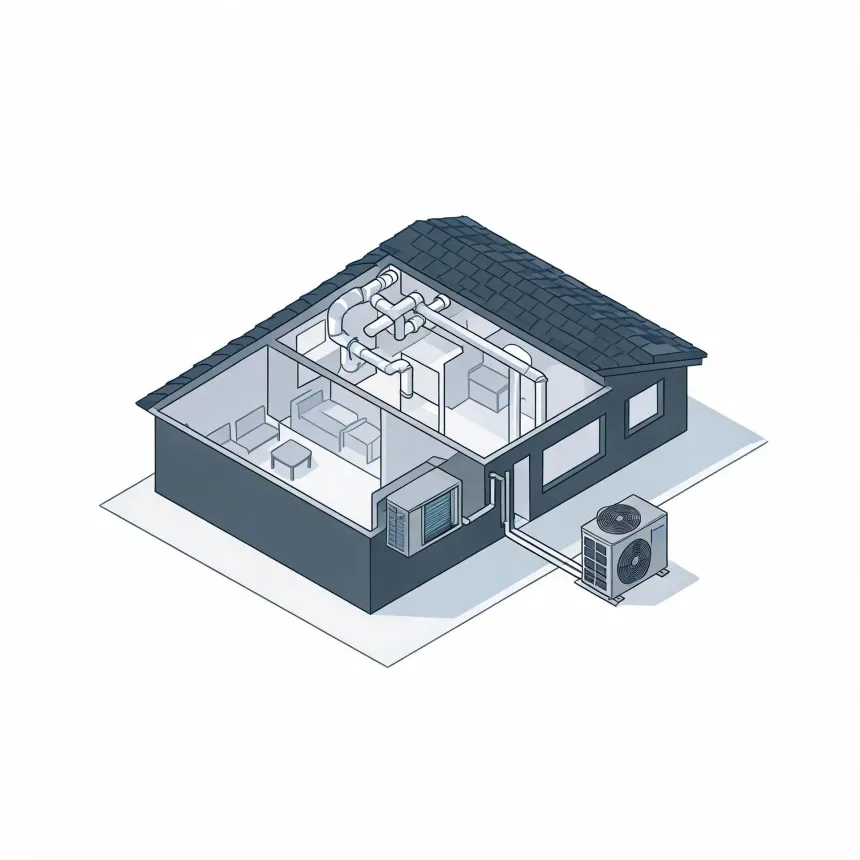
Isometric line illustration of a cutaway single-story house showing interior rooms with furniture, ceiling ductwork, an indoor air handler, and an outdoor condenser unit connected by lines along the exterior wall.
Your air conditioner works hardest from July through August.

NOAA nClimDiv, 1991–2020 normals

Idaho electricity ran 11.52 cents per kilowatthour in 2024, cheaper than most of the country.

At that rate a high-efficiency AC takes longer to pay for itself, so pick the system for how well it fits and holds up, not just its efficiency rating.

Salmon doesn't ask more of an AC than a standard system can handle

Half the homes here were built by 1979
Summer afternoons average 73°F
15 damaging wind events from 2015 to 2024
Salmon doesn't ask much of an air conditionerSummer afternoons here average 73°F, and no month gets warm enough to call for cooling at all.

So what does fit and holdup mean when you're the one picking a model. Ask what the warranty covers and for how many years, on both the compressor and the parts around it. Ask how long the brand has been selling that particular line, since a unit with a longer track record gives you more to go on than one that just hit the market. A two-stage or variable-speed compressor costs more up front and runs quieter, but in a place where power is cheap, that upgrade is about comfort and noise, not about the electric bill. A contractor who installs here regularly can tell you which brands hold up through a Salmon winter and which ones come back for service too often.

Choose for reliability, not for a rating you won't need

A 73°F summer afternoon doesn't strain a system, so there's no reason to pay extra for top-tier efficiency here. Pick a unit with a solid warranty and a track record in Salmon, and it should run fine for years.

Find a contractor
A man in a cap, dark long-sleeved shirt and brown work pants carries a canvas tool bag as he climbs porch steps toward a green front door.
A gray cylindrical air conditioning condenser unit mounted on a concrete pad next to a light-colored vinyl-sided house exterior.

The rating measures the machine, not the years it'll give you

That rating comes from lab tests measuring how much cooling the unit delivers against how much electricity it draws, averaged over a full year of use. It tells you how well the system converts power into cooled air, nothing about how long it lasts or how often it breaks down. A unit can carry a high rating and still need a service call every year if the install was rushed or the refrigerant charge was never set right. The rating also assumes the coil stays clean and airflow stays steady, so a clogged filter or a blocked return can quietly drag real performance below what the label promises. None of that shows up on the label. It only shows up in how the system runs once it's in the house.

The ductwork decides more than the unit does

If the ducts already in place are sized wrong or leak at the joints, a contractor has to fix that before the new system can work right. Sealing or resizing duct runs takes more labor than swapping in a new condenser and air handler, and no thermostat setting fixes airflow that the ducts can't deliver.

Where the equipment sits adds steps

A straight swap in the same spot with the same electrical and the same duct connections goes faster than a install that moves the air handler, reroutes a line set, or calls for a new disconnect box. Tight attic access or a condenser pad that needs releveling adds time before any cooling parts get connected at all.

Aerial view of a gray central air conditioning condenser unit on a concrete pad next to a house with vinyl siding.

Going above the federal minimum saves little here, about $0 a year.

  • A new unit at the federal minimum, 13.4 SEER2$20 a year
  • A higher-efficiency unit$20 a year

Estimates for a typical Lemhi County home, from EIA household energy data, Idaho fuel prices and NOAA climate normals. Your home will differ.

Install day starts with taking the old equipment out, not putting the new in. The condenser gets disconnected and the refrigerant recovered. The old line set and air handler come out too if they're not being reused. Only then does the new equipment go in, get set on its pad or platform, and get tied into the ducts, the line set and the electrical. Once it's all connected, the system gets evacuated to pull moisture and air out of the line set before any refrigerant goes in. Charging it right means weighing in refrigerant or checking pressures against the manufacturer's numbers, not just running it until the air feels cold. Startup comes last. That means checking airflow at the vents, checking the temperature difference between the return and supply air, and making sure the thermostat is actually talking to the new system before anyone leaves.