





A stack of split firewood in a black metal rack sits on a gravel bed against the dark vertical board siding of a house, with dry grass, pines and an overcast sky beyond.

Heat Pump Repair in Gooding, ID

Tell us about the job

Takes about a minute. No obligation.

RepairHeat PumpGooding County, ID
Step 1 of 2

What ZIP code is the job in?

A heat pump here works for eight months straight, October through May, then sits for two. That long run is where weak parts tend to give out, usually right in September when the switch to heat puts a different kind of strain on the system than cooling did. A reversing valve that was sluggish all summer can stick for good once it has to hold the heating position day after day. Same with a capacitor that's been borderline. If your heat pump is struggling to keep up or short cycling as the weather turns, that's not a coincidence of timing, it's the system telling you something was already wearing thin.

8 months
October through May, your system heats
2 months
July through August, it cools
21°F
the average winter night it heats against
86°F
the average summer afternoon it cools against
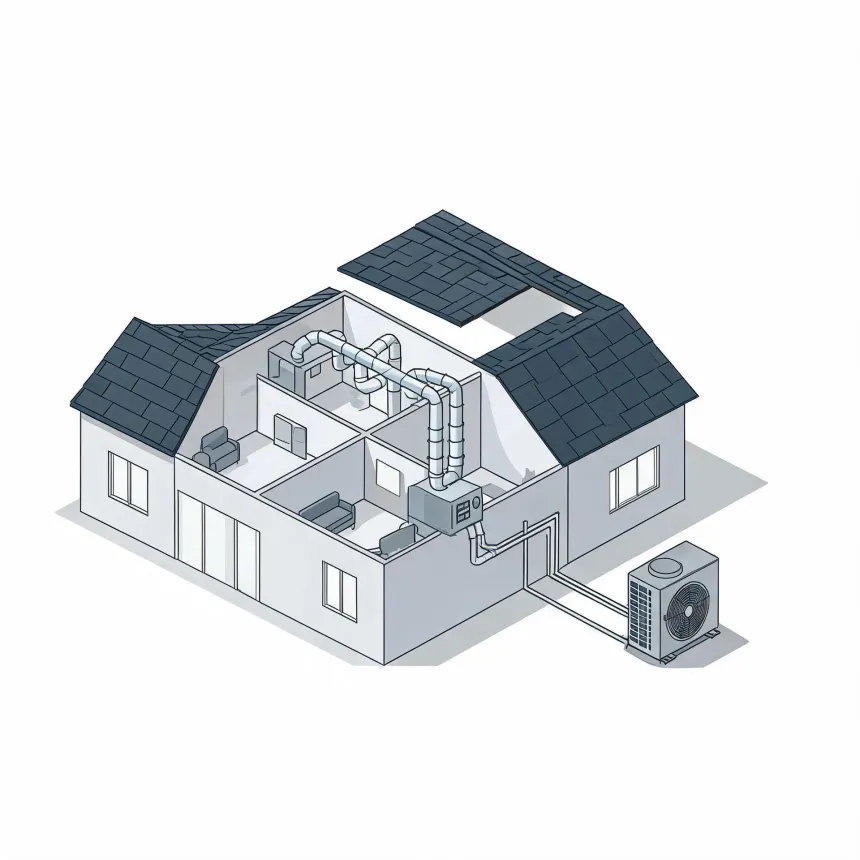
Isometric line illustration of a cutaway single-story house showing interior rooms, ceiling ductwork connected to an indoor air handler, and refrigerant lines running to an outdoor condenser unit on a pad.
Your system heats October through May and cools July through August.

NOAA nClimDiv, 1991–2020 normals

A heat pump low on refrigerant won't shut off on its own, it just keeps running trying to hit the thermostat setting.

The compressor carries that extra strain the whole time, and a compressor that fails usually takes the whole system down with it.

Gooding winters are cold, not extreme, on a heat pump

12 winter storms from 2015 to 2024
Winter nights average 21°F
Power costs 11.52 cents a kWh statewide
An old house or a mobile home doesn't change thisHalf the homes in Gooding County were built in 1976 or earlier, and 15.7% are mobile homes.

An overnight low around 21 degrees in January is well within what a heat pump is built to handle. That means a repair is usually a straightforward fix, not a sign the unit is beat. If yours is short cycling or running without heating well, it's worth having a contractor look at it rather than planning to replace it. When ice storms knock the power out, most heat pumps start right back up on their own once it's restored. If yours doesn't, that's worth a call too, since it points to something else going on.

Get it looked at early

Problems tend to show up in the first weeks of the season, when the load hits a part that was already weak.

Find a contractor
A man in a cap, dark shirt and tan work pants carries a canvas tool bag up stone steps toward a green front door flanked by potted shrubs.
A gray heat pump outdoor unit mounted on a concrete pad next to the stone-accented exterior wall of a house.

What the running itself starts to show

A heat pump that's run nonstop for weeks shows wear in specific ways. Ice building up on the outdoor coil and not clearing during the defrost cycle is one. Air coming out of the vents that's barely warm, or warm then cold, is another. Listen for the outdoor unit cycling on and off more than it used to, or running long stretches without the house ever feeling warm. A reversing valve that hums but doesn't shift, or clicks and seems to stick halfway, is worth a call before it fails completely. None of these mean the unit is done. They mean a part is working harder than it should to do the same job.

Most failures trace back to a few parts

The capacitor, the reversing valve, the defrost control board and the contactor account for most heat pump breakdowns. These are the parts that cycle every time the system switches modes or starts up, and that repeated strain is what wears them down over years of normal use.
The compressor is the exception

A failed capacitor or contactor is usually a straightforward swap, and the system runs fine again once it's in. The compressor doesn't fail on its own like that. It usually only goes after something else, a refrigerant leak or an electrical fault, has been straining it for a while, and by then the damage is already done.

There are a few things worth checking before you pick up the phone. Start with the thermostat, make sure it's set to heat and the setting is actually above room temperature. Then check the outdoor unit. If the coil is caked in ice or buried in leaves and debris, airflow is blocked and the system can't do its job. Look at the air filter too, a clogged one chokes the whole system and can show up as weak heat or short cycling. Check your breaker panel for anything tripped, since a heat pump that won't start at all sometimes just needs power restored. If you've done all that and it's still not heating right, the problem is inside the system, and that's where it stops being a homeowner job.

A diagnostic call starts outside at the unit itself, before any panel comes off. The tech checks that the outdoor fan spins freely and the coil is clear, then moves to static readings, checking refrigerant pressures and electrical draw against what the system is supposed to pull. From there it's the sequence of a heating cycle, watching whether the reversing valve actually shifts when it's told to and whether the defrost cycle kicks in and clears the coil the way it should. Capacitor and contactor get tested under load, not just looked at, since both can look fine sitting still and still be the problem. If something's drawing more amps than it should or the pressures are off, that points straight to which part is failing before anything gets replaced. The goal is to find the one part actually causing the symptom, not to start swapping things and see what helps.