Illuminated timber-and-stone houses line a residential street at dusk, with evergreen trees in the foreground and a silhouetted mountain range behind them.

Heat Pump Repair in Jerome, ID

Tell us about the job

Takes about a minute. No obligation.

RepairHeat PumpJerome County, ID
Step 1 of 2

What ZIP code is the job in?

The reversing valve sticks or fails

The reversing valve is what switches a heat pump between heating and cooling. It can stick in one position or start leaking refrigerant internally, and when it does, the system blows the wrong temperature air or stops switching modes at all. It takes a trained hand to diagnose because the symptoms look electrical even when the valve itself is the problem.


The outdoor coil and defrost cycle take the punishment

The outdoor unit sits outside year round, so its coil collects dirt, ice and debris that a furnace never has to deal with. The defrost board and sensor that clear that ice off are common failure points, and a bad sensor can leave the coil frozen over until the whole system loses its ability to heat or cool.

9 months
September through May, your system heats
2 months
July through August, it cools
22°F
the average winter night it heats against
85°F
the average summer afternoon it cools against
Isometric line illustration of a cutaway single-story building showing interior rooms, ceiling ductwork, an indoor air handler, and an outdoor condenser unit connected by refrigerant lines.
Your system heats September through May and cools July through August.

NOAA nClimDiv, 1991–2020 normals

Winters here average 22°F overnight, not deep sub-zero cold.

A heat pump in Jerome isn't running flat out all winter, so a repair now usually puts it back to normal work, not a losing fight.

August is the last easy month before nine months of heat begin in September

Cooling runs July through August
Heat runs September through May
12 winter storms from 2015 to 2024

Since the system isn't working as hard here, a repair gets a unit back to normal duty instead of patching something that was already overworked. That matters when a tech is telling you whether a part is worth replacing. A reversing valve or defrost sensor that failed after a mild winter usually failed on its own, from age or dirt in the coil, not from the system fighting sub-zero air for months. Worth knowing before you decide whether to fix it or start pricing a new one.

A newer home usually means a heat pump worth repairing

Half the homes in Jerome County were built in 1983 or later, so there's a good chance yours is one of them. A heat pump that came with a newer house usually hasn't logged the years that push a system toward replacement. Get the repair diagnosed and keep it running.

Find a contractor
A gray outdoor HVAC unit mounted on a concrete pad beside a house with gray lap siding and a stone foundation.

What wears a heat pump down isn't the cold, it's the switching

A heat pump doesn't wear out evenly across the year. Most of its cycling happens in the shoulder months, when it's switching between heating and cooling modes as the temperature swings, and that's exactly the work that puts the most stress on a reversing valve. Every switch is a chance for it to stick. A system that's logged years of those seasonal swings has usually put more wear on that valve than one still on its first few years. Age matters less than how many times it's been asked to change direction. A valve or defrost sensor that's original to the unit and still working fine after years of switching is a good sign the rest of the system is holding up too.

The system blows air at the wrong temperature

A heat pump that's cooling when it should be heating, or putting out air that never feels fully warm, is usually a reversing valve stuck between positions. It's not a thermostat setting worth fiddling with. The system needs a tech to check it before the valve fails completely.

The outdoor unit is iced over or won't stop running

A coil caked in ice that doesn't clear during the defrost cycle means that cycle isn't working right. A unit that runs constantly without ever satisfying the thermostat is trying to move heat it can't get to. Both point to a system losing ground, not one that just needs more time.

A few things are worth checking before a tech ever shows up. Look at the outdoor unit itself. If the coil is buried in ice or snow isn't clearing from around it, that's airflow the system can't get back on its own. Check the air filter inside, since a clogged one starves the system the same way a blocked coil does. Walk around the outdoor unit and clear leaves, mulch or anything stacked against it, because that unit needs open air on all sides to work at all. Check the thermostat batteries and settings, since a heat pump stuck on the wrong mode sometimes traces back to something that simple. If the breaker's tripped, you can reset it once, but if it trips again, stop and leave that one for a tech.

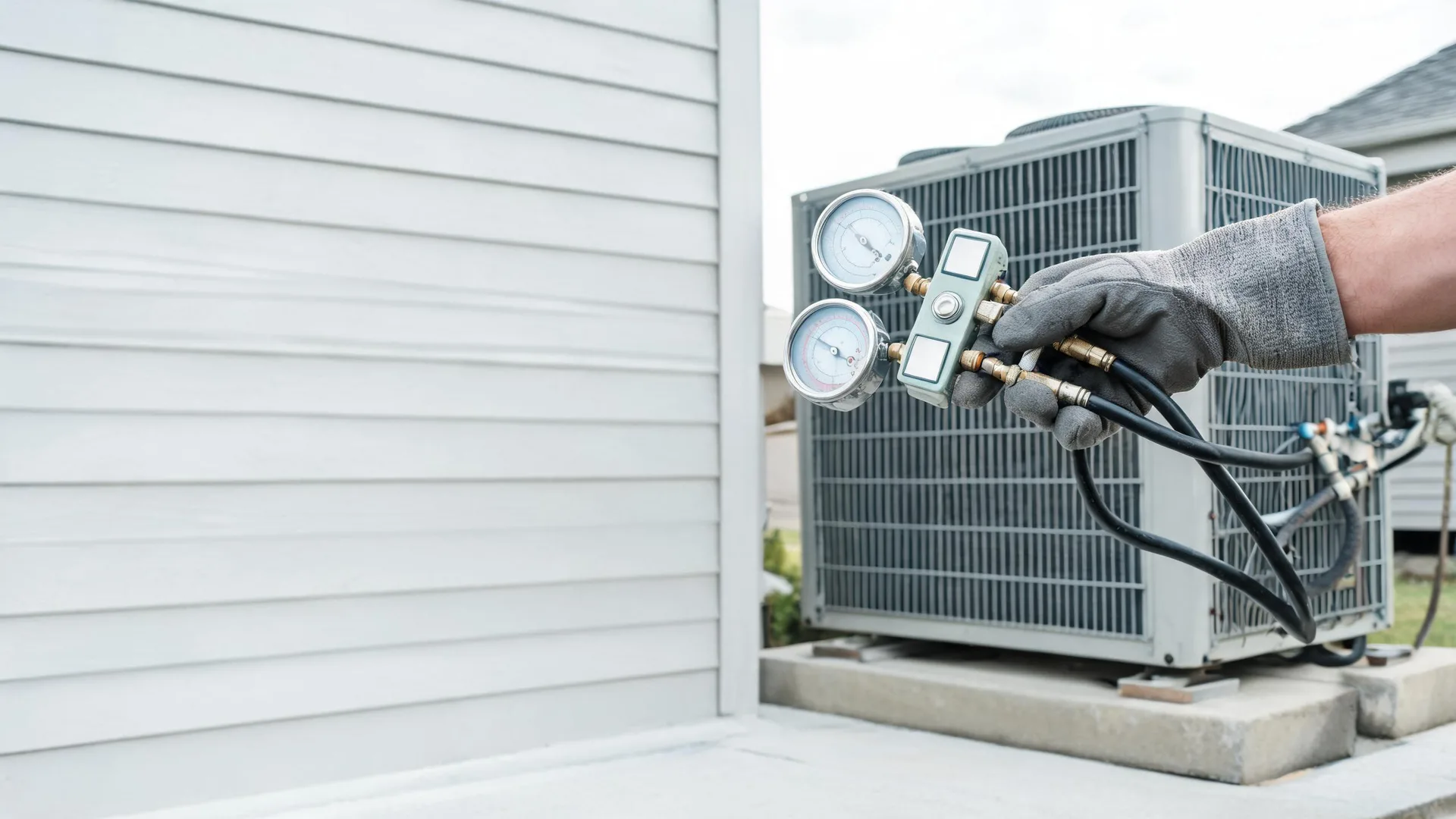
A diagnostic starts outside, since that's where a heat pump does the hard work. A tech checks refrigerant pressure first, because a low charge shows up fast on the gauges and explains a lot of what the homeowner noticed. From there it's the reversing valve, tested by forcing the system to switch modes and watching whether it actually does. The defrost board gets checked too, along with the sensor that tells it when to kick on. None of this is guesswork. Each test rules something in or out, and by the time the gauges and meter come out, the tech usually already has a good idea which part is failing.