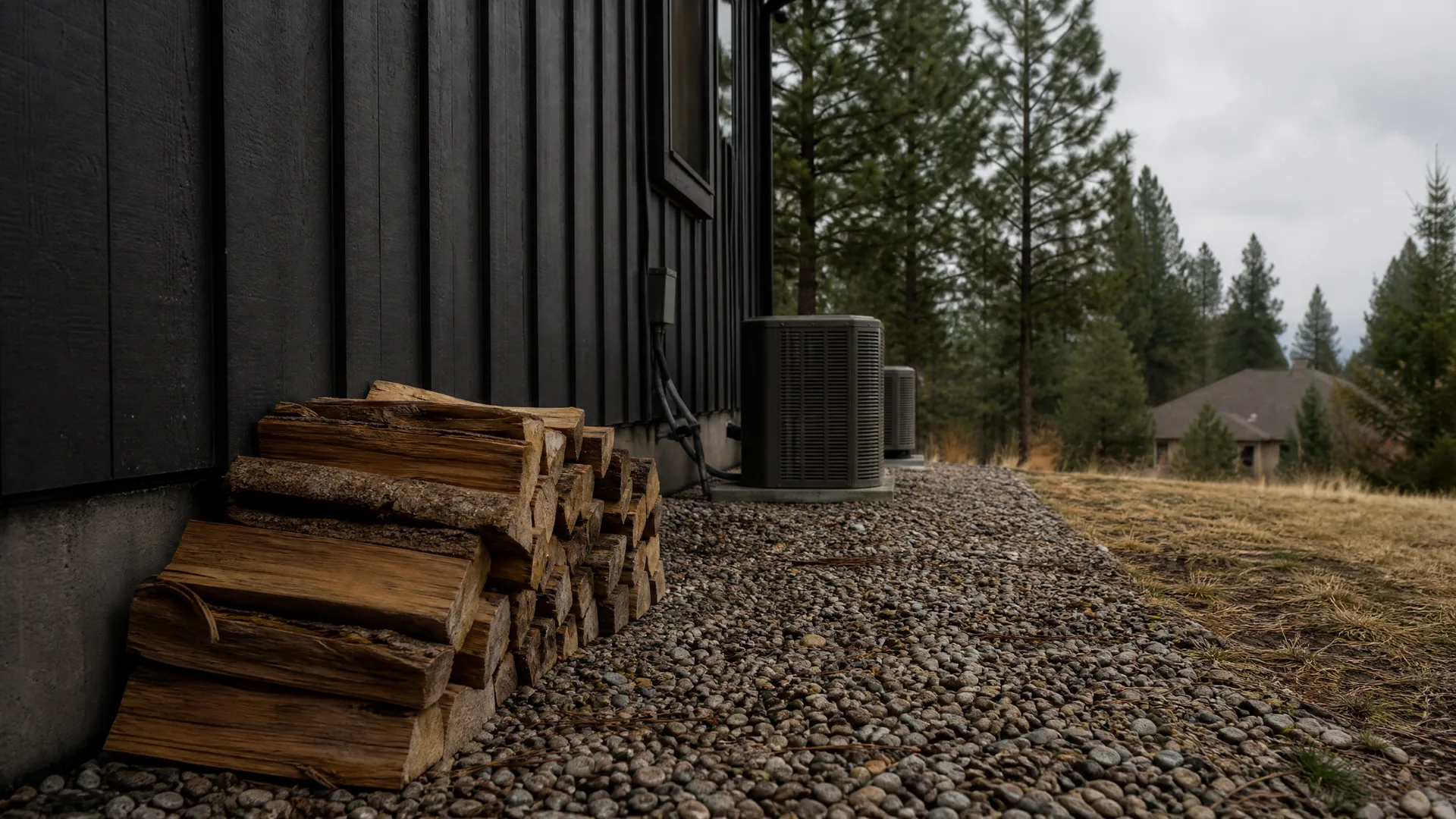
Stack of split firewood against the dark board-and-batten wall of a house, with two outdoor condenser units on a gravel strip, dry grass and conifer trees beyond under an overcast sky.

Heat Pump Repair in Nampa, ID

Tell us about the job

Takes about a minute. No obligation.

RepairHeat PumpCanyon County, ID
Step 1 of 2

What ZIP code is the job in?

The system is running but not keeping up

A heat pump that runs long cycles without bringing the house to temperature is often low on refrigerant or struggling with a failing compressor. Air coming out lukewarm instead of warm or cool points the same direction. The unit outside may also be caked in frost during a cycle when it shouldn't be, which usually means the defrost control or a sensor has failed.


Strange noise or smell means call now, not later

A grinding, screeching or banging sound from the outdoor unit usually means a motor bearing or compressor part is wearing out, and running it longer can turn a repair into a replacement. A burning smell from the indoor vents means shut it off and get a technician out before running it again.

8 months
October through May, your system heats
3 months
June through August, it cools
25°F
the average winter night it heats against
89°F
the average summer afternoon it cools against
Isometric illustration of a cutaway single-story house showing interior ductwork and vents connected to an outdoor condenser unit beside the building, on a white background.
Your system heats October through May and cools June through August.

NOAA nClimDiv, 1991–2020 normals

Nampa winters average 25°F at night, not deep cold that pushes a heat pump to its limit for months straight.

A heat pump here spends most of the year working well within its range, so a repair is usually fixing a part, not fighting a system that's been run ragged.

October is when a weak part gets found

Cooling runs June through August
Heat runs October through May
37 winter storms from 2015 to 2024
Canyon County's homes run youngHalf the homes in Canyon County were built in 1999 or later, so there's a good chance yours was too.

That's worth knowing before you decide whether a repair makes sense. A unit that hasn't been fighting extreme cold for months is less likely to have a cascade of worn parts behind the one that failed. So if a technician finds a bad capacitor or a failed defrost sensor, that's usually the whole story, not the first sign of a system in broader decline. Canyon County does get hit with winter storms, 37 of them over the past decade, but those are short, sharp events, not a long season of strain. A repair now is more likely to hold.

It's usually worth repairing

It has an easier job here than in most places, so your heat pump is often in decent shape. Repair is usually worth it.

Find a contractor
A gray heat pump condenser unit mounted on a concrete pad against the gray lap-siding exterior wall of a house.

Running it through a problem rarely fixes the problem

A heat pump that's struggling doesn't fail all at once. It fails a little more with every cycle it's forced to run through. A low refrigerant charge makes the compressor work harder to move the same amount of heat, and that extra strain shows up as higher temperatures inside the compressor shell. Run it long enough in that state and the compressor windings or bearings wear down faster than they would otherwise, turning a refrigerant leak into a compressor replacement. A failing capacitor is similar. It still gets the motor started, just barely, drawing more current each time to do it, and that extra draw heats up the motor windings it's trying to spin. Ice on the outdoor coil is its own kind of trouble, because a unit icing over and running anyway pushes liquid refrigerant back toward the compressor instead of vapor, and compressors aren't built to handle liquid. A grinding or screeching motor bearing wears through to metal on metal if it keeps turning, and at that point the motor seizes instead of just getting noisy. None of these start as emergencies. They get called in as one because the system kept running on a part that needed to stop.

Age and history matter more than the symptom

A heat pump that's had regular filter changes and a clean outdoor coil usually keeps most of its parts in working order. One failed capacitor or a stuck contactor on a unit like that is just a part worn out, and replacing that part brings it back to normal. The same symptom on a unit that's been neglected, iced over repeatedly, or already patched once before is more likely one sign among several, and a tech will often check the compressor and refrigerant charge before calling it a simple fix.

What decides it is what else is wearing out

A failing part is worth repairing on its own. The harder call is when a technician finds the compressor itself losing efficiency, or the refrigerant circuit has been low more than once. Those point to the core of the system wearing down, not a single component. At that point a repair might solve today's problem and still leave the next one close behind, and that's the thing worth asking the technician directly before deciding.

Before anyone comes out, there are a few things worth checking yourself. Look at the outdoor unit and clear away any leaves, dirt or ice built up around the coil, since restricted airflow there can mimic a bigger problem. Check the thermostat is set to heat or cool as intended and the batteries aren't dead, since a blank or frozen display sends people looking for a repair they don't need. Go to the breaker panel and see if the breaker for the outdoor unit or air handler has tripped. Replace the air filter if it's been a while, because a clogged filter chokes airflow and can make a healthy system seem like it's struggling. None of this fixes a bad capacitor or a failing compressor, but it rules out the simple stuff first.

A diagnostic visit starts outside, not at the thermostat. A technician will pull the panel off the outdoor unit and check the contactor, the capacitor and the wiring before touching anything else, because those fail more often than the compressor itself. Gauges go on next to read the refrigerant charge and head pressure, which tells them whether the compressor is pulling its weight. Indoors, they'll check the air handler for a frozen coil or a clogged filter, since either one can look like a failing system when it's really just restricted airflow. They'll also run the system through a full heating and cooling cycle to watch the reversing valve switch, because a valve that sticks only shows itself mid-cycle. Most of this is listening and watching the system work, not guesswork.