






A gravel road lined by a split-rail log fence on the left and dark-sided cabins with metal roofs on the right, surrounded by tall conifers under an overcast sky.

Heat Pump Repair in Payette, ID

Tell us about the job

Takes about a minute. No obligation.

RepairHeat PumpPayette County, ID
Step 1 of 2

What ZIP code is the job in?

A heat pump in Payette County earns its keep most of the year, cooling from June through August and heating October through May. That long heating stretch is why September matters. A heat pump that struggled at the end of last winter doesn't fix itself sitting idle through the summer. The same weak capacitor or low charge is still there when it switches back to heating in October, and the first cold mornings are when it gets found out. If yours has been making a strange noise or not keeping up, getting it looked at before October beats waiting for the night it stops.

8 months
October through May, your system heats
3 months
June through August, it cools
25°F
the average winter night it heats against
88°F
the average summer afternoon it cools against
Isometric line illustration of a cutaway house showing interior rooms with furniture, a furnace or air handler with overhead ductwork, and an outdoor condenser unit connected by lines outside the wall.
Your system heats October through May and cools June through August.

NOAA nClimDiv, 1991–2020 normals

Payette winters hold around 25°F overnight, not deep cold.

A heat pump here isn't fighting extreme temperatures all winter, so a repair is usually worth doing.

Half these homes were built by 1978. That's not why your heat pump is struggling.

Half the homes here were built by 1978
37 winter storms from 2015 to 2024
Winter nights average 25°F

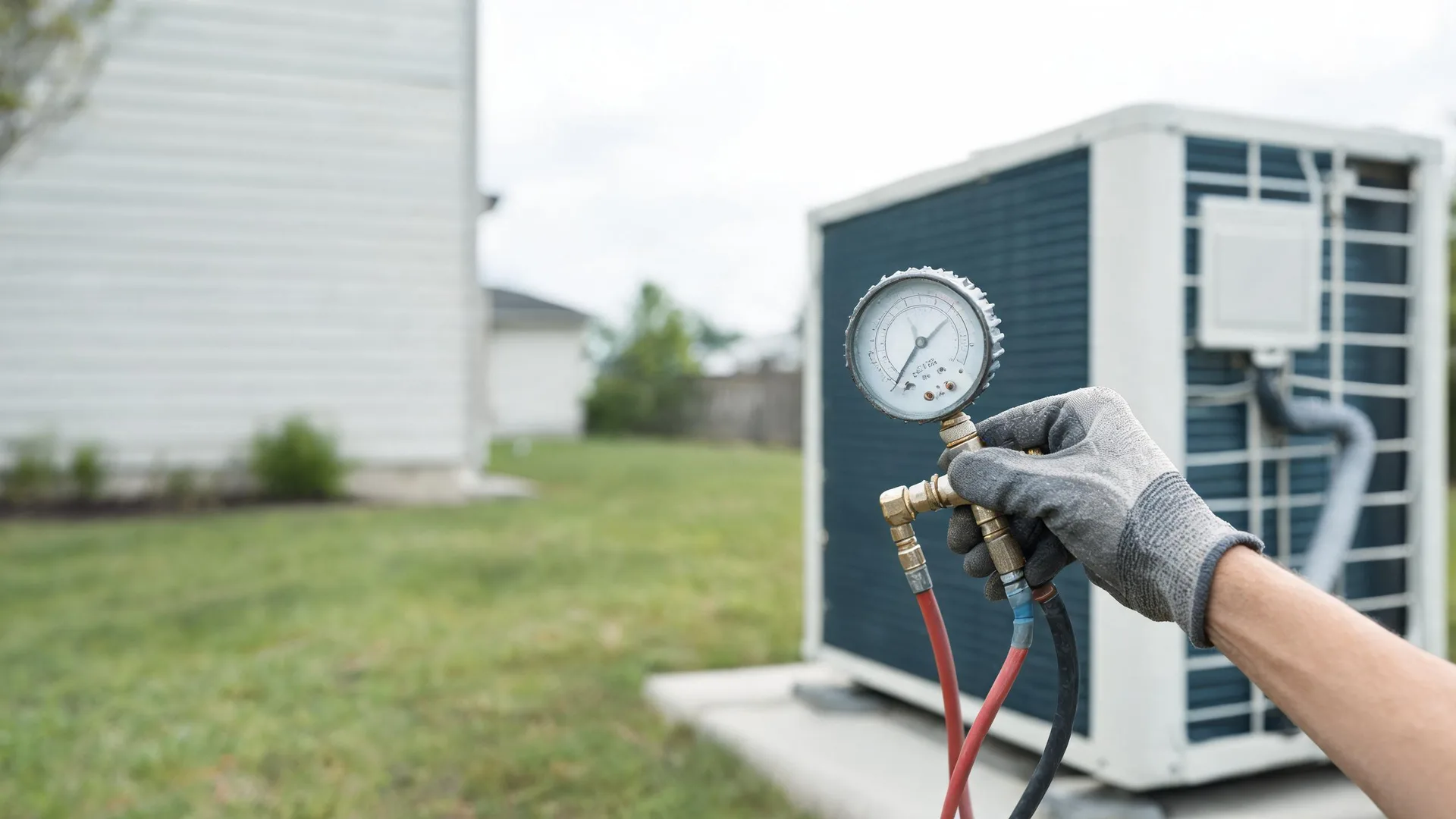
A diagnostic visit starts outside at the unit, not inside with the thermostat. A technician checks refrigerant pressure, looks at the reversing valve, and watches how the system responds when it's told to switch modes. Electrical readings come next, the capacitor, the contactor, the readings on the compressor itself, since a lot of failures show up as a number that's outside the range it should be in. None of this takes long, and most of it doesn't involve opening anything up. Where it takes longer is tracing a refrigerant leak, since the gauge tells you the charge is low but not where it's getting out. That part sometimes means checking fittings and coils one at a time until the leak shows itself.

Get it looked at early

Problems tend to show up in the first weeks of the season, when the load hits a part that was already weak.

Find a contractor
A man seen from behind in a backward cap, dark jacket and tan work pants carries a waxed canvas tote bag up steps toward a green front door, with a potted shrub beside the entry.
A dark gray heat pump unit mounted on a concrete pad next to a house with gray siding and a stone veneer wall.

What you can check yourself

Start with the thermostat. Make sure it's set to heat and the batteries aren't dead, since a dead battery looks exactly like a dead system. Go outside and look at the coil. If it's covered in leaves, dirt or ice, that alone can make a heat pump struggle or quit, and you can clear debris away by hand. Don't chip at ice, let it go. Inside, pull the air filter and hold it to a light. If you can't see through it, swap it or clean it, a clogged filter starves the system of airflow and will shut it down on its own. Walk the house and check that supply vents are open and nothing's stacked in front of a return. Check the breaker panel for anything tripped and reset it once. If it trips again, leave it off and call someone, that's not a job to force. If the outdoor coil stays iced over well past when it should have cleared on its own, the defrost cycle likely isn't working. None of this tells you exactly what's wrong inside the unit, but it clears away the simple stuff before anyone has to open the cabinet.

It's blowing air that isn't warm or cold

A heat pump moving air that feels like room temperature, not warm, not cold, is usually stuck between modes or losing refrigerant. It hasn't stopped, but it isn't doing its job either. That's worth a call, not a wait and see.
It's running constantly without catching up

A heat pump that never shuts off and still doesn't reach the set temperature is working against something, a failing compressor, a low charge, or a reversing valve stuck halfway. Letting it run like that for days just adds wear to whatever's already failing.

Storms are a different risk than cold, and Payette gets them. Heavy snow, ice or blizzards hit the county 37 times between 2015 and 2024. None of that comes from how hard the heat pump works day to day. A branch or built-up ice can knock the outdoor unit around or block the coil outright, and that kind of damage can look a lot like a part giving out on its own. Worth mentioning if your trouble started right after a storm. It changes what a technician checks first, not whether the repair is worth doing.

Age matters more than the symptom when you're deciding whether to fix a heat pump or replace it. A compressor failure on a unit that old usually isn't worth chasing with a repair, since the compressor is most of the system's value and cost. A bad capacitor or a failed run condenser on the same old unit is a different story, those are cheap parts regardless of the unit's age and almost always worth replacing. The harder case is a system in the middle of its life that needs a major part. There the question isn't just the one repair, it's whether other parts are likely to start failing the same way, since a unit that's lost one major part under normal wear often isn't far from losing another.