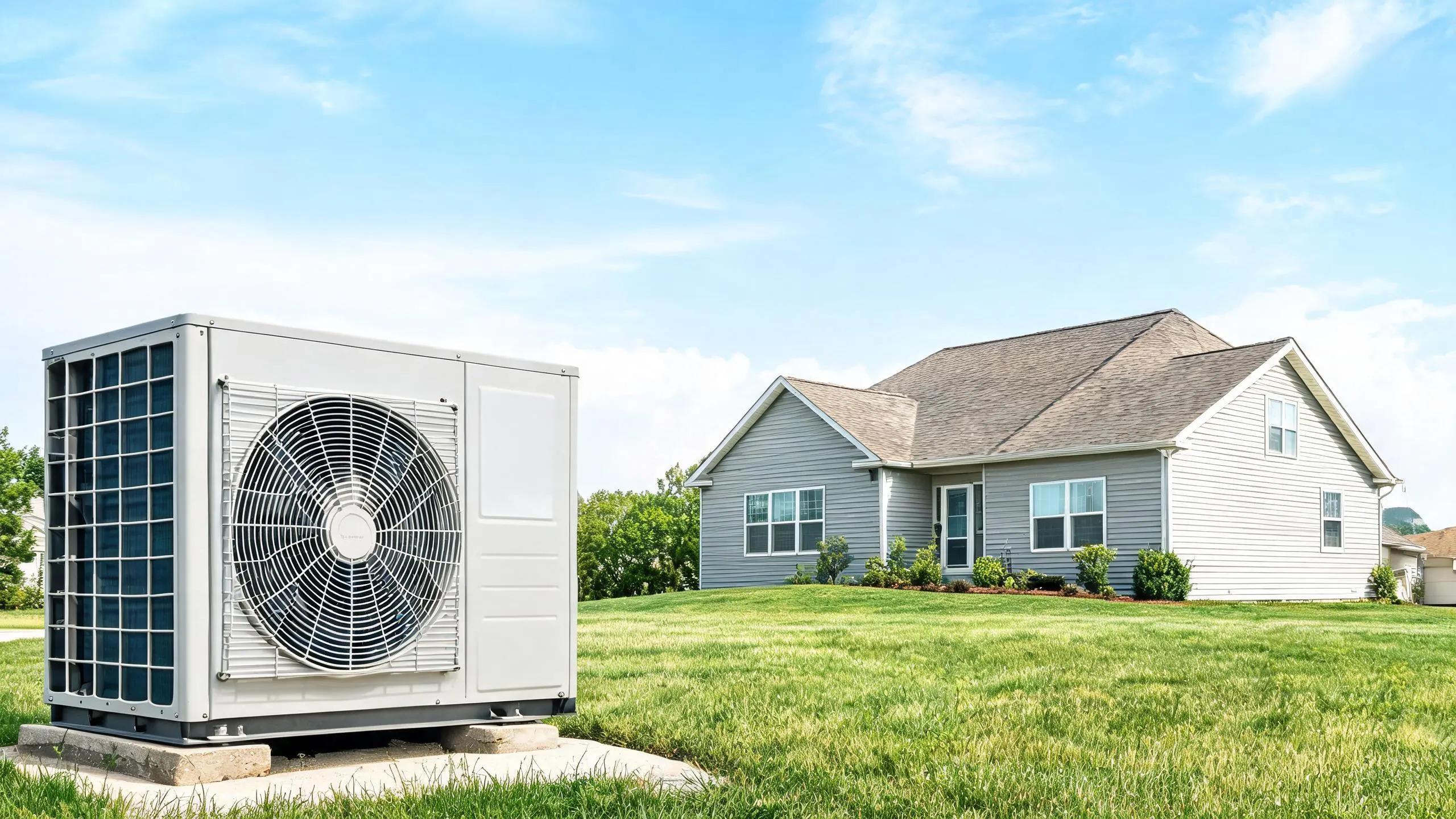
An outdoor HVAC condenser unit on a concrete pad in front of a single-story house with gray siding and a shingle roof.

Heat Pump Repair in Rigby, ID

Tell us about the job

Takes about a minute. No obligation.

RepairHeat PumpJefferson County, ID
Step 1 of 2

What ZIP code is the job in?

Cold snaps are normal here, not a special strain

Rigby winters average around 11°F overnight in December, January and February. A heat pump built for this area is sized for that cold. If yours is struggling to keep up or running constant backup heat, the cause is almost always a worn part or a system losing efficiency. It is not the weather beating it.


Find the part that failed

A heat pump that won't switch out of defrost, won't heat past a certain point, or short cycles usually has one cause behind it. A reversing valve stuck in position, a low refrigerant charge, a failing defrost sensor. A contractor can test for the specific cause and repair that part instead of guessing.

10 months
September through June, your system heats
2 months
July through August, it cools
11°F
the average winter night it heats against
83°F
the average summer afternoon it cools against
Isometric cutaway illustration of a small house showing ducted air distribution, an indoor air handler, and an outdoor condenser unit connected by lines, with a sofa and bed in the rooms.
Your system heats September through June and cools July through August.

NOAA nClimDiv, 1991–2020 normals

Heat runs here from September through June.

A heat pump that's already weak tends to fail in August, right as it has to switch over and carry the load.

Half the homes here were built in 1994 or later, and the heat pump inside is probably that age too

Half the homes here were built by 1994
144 damaging wind events from 2015 to 2024
58 winter storms from 2015 to 2024

Jefferson County logs its share of weather, mostly wind and winter storms rather than hail or tornadoes. None of that points to a heat pump problem that's different from what shows up anywhere else. Wind can knock out power, and when power drops, some heat pumps don't restart on their own. If yours won't come back after an outage, check the breaker and the thermostat settings before assuming the unit failed. Outside of that, a unit that's cycling wrong or losing heat has a part behind it worth finding, not a county that's harder on equipment than most.

Find the part before it costs more to ignore

A heat pump that's losing heat or cycling wrong has a specific part behind it, and that part only gets easier to find once a contractor is looking at the unit. Idaho homes paid 11.52 cents per kilowatt-hour in 2024, and a heat pump leaning on backup heat to make up for a bad part runs that cost up for as long as it's left alone.

Find a contractor
A man seen from behind in a backward cap, dark jacket and tan work pants carries a waxed canvas tote bag up steps toward a green front door, with a potted shrub beside the entry.
A dark gray heat pump unit mounted on a concrete pad next to a house with gray siding and a stone veneer wall.

What to check before the truck shows up

Before calling anyone, check the thermostat first. Make sure it's set to heat and not idling in fan-only mode, and check the batteries if it uses them. Go to the breaker panel and look for a tripped breaker, not just a flipped switch but one that's sitting in the middle. Outside, look at the unit itself. Clear away anything blocking the sides, leaves, snow, a cover someone left on it. If the outdoor coil is caked in ice beyond what you'd see during a normal defrost cycle, that's worth noting for the contractor, not something to chip off yourself. Check your air filter too. A filter clogged with dust forces the system to work harder and can bring on a lot of the same symptoms as a failing part. Inside, make sure every supply vent is open and nothing's been pushed up against a return. None of this fixes a bad reversing valve or a low charge, but it rules out the simple stuff before anyone drives out to look at it.

A refrigerant leak only gets bigger

A heat pump low on charge will keep running, just worse. The compressor has to work harder to move heat with less refrigerant in the system, and that extra strain is what burns it out. A small leak left alone usually means a compressor replacement instead of a patched line.

A failing part drags down the ones around it

A weak capacitor makes the compressor or fan motor pull harder to start. A stuck reversing valve forces the system to fight itself between heating and defrost. The longer it runs that way, the more the motor itself wears, and that turns a part job into a bigger repair.

Most heat pump failures come down to a handful of parts, and they tend to fail the same way every time. The reversing valve sticks from wear on its seals after years of switching between heating and cooling. A defrost sensor or control board loses the ability to read the coil temperature correctly, so the unit either won't defrost or won't stop defrosting. Contactors and capacitors wear out from the daily load of starting the compressor and fan motor. Once a capacitor weakens, the motor it feeds pulls harder every time it starts, and that extra strain shortens the motor's life too. Refrigerant leaks show up slowly at fittings and coil joints, so the system keeps running while it quietly loses capacity. Weak heat, short cycling, a unit stuck in defrost all trace back to wear on the parts doing the most work.

A repair decision usually comes down to what actually failed, not just how old the unit is. A capacitor, a contactor, a defrost sensor, these are cheap to replace and don't say anything about the rest of the system. Swap the part and the unit runs like it did before. A compressor is different. It sits at the center of the system, and if it's failing, usually from years of strain or a refrigerant leak that went unfixed too long, the repair starts competing with the cost of a new unit. The honest way to judge it is to ask what's actually broken and whether the rest of the system is sound, not to assume age alone settles it. A unit that's had one part fail isn't the same as one where several parts are wearing out at once.