August is the month to catch it
Heat here starts up in September, so a heat pump that's struggling now is worth checking in August before the cold sets in. Whatever is wrong tends to show itself under the first real load, not before.
Takes about a minute. No obligation.
Heat here starts up in September, so a heat pump that's struggling now is worth checking in August before the cold sets in. Whatever is wrong tends to show itself under the first real load, not before.
A heat pump in Benewah County runs from September through June. That kind of stretch puts steady hours on the same parts, and a weak one usually fails right when the system has to work hardest, not while it's idle.

Check the outdoor unit first. If the fan isn't spinning or the coil is packed with ice, that tells you something before anyone shows up.
Inside, check the thermostat batteries and the air filter. A clogged filter or a dead battery can look exactly like a failing system.



A heat pump that's icing up or short cycling will keep running if you let it, and that's the problem. Ice on the outdoor coil blocks airflow, so the system pulls harder to move the same amount of heat, and that strain lands on the compressor. Short cycling does similar damage. Every start draws a surge of current, and a unit that's kicking on and off all day sees far more of those surges than one running a normal cycle. A refrigerant leak behaves the same way. Low charge makes the compressor work to pump refrigerant that isn't there, and it runs hotter than it's built to. None of these fix themselves by waiting. The part absorbing the extra strain wears down a little more each hour the system stays on, and what would have been a simple repair early on turns into a compressor replacement later.
Homes in Benewah County split about evenly between built in 1979 or earlier and built since, and close to one in five is a mobile home. None of that changes how a heat pump fails. Old house or new, mobile home or site-built, the same parts wear the same way and get fixed the same way. The question is whether it gets looked at before the strain turns a repair into a replacement.
Find a contractorA heat pump wears out over years, not days, so the real question is how much life is left in the parts around whatever just failed. A compressor failure late in a unit's life usually means replacement, since the labor to swap it costs most of what a new system would run and the rest of the unit has the same hours on it. A failed capacitor, a bad contactor, a blower motor on its way out, those are repairs regardless of age, because they're wear parts that fail on their own schedule and swapping one doesn't leave the rest of the system any older. The age of the unit matters less than whether this is the first real repair it's needed or the third one this year. A unit that keeps coming back for different problems is telling you something the last repair didn't fix, which is that the system as a whole is wearing out, not just the one part that broke.
A heat pump has to switch directions to heat instead of cool. That job falls to the reversing valve. When it sticks, the system can get stuck in one mode or stop heating altogether. The defrost cycle depends on a sensor and a control board reading it correctly. If that sensor drifts or fails, the unit either never defrosts and ices over, or defrosts too often and can't hold heat.
A capacitor gives the compressor and fan motors the jolt they need to start. Capacitors weaken slowly, so the symptom is often a unit that hums and doesn't start, or a fan that spins slowly before it catches. A contactor has a simpler job. It closes the circuit so the compressor gets power at all. The contacts pit and burn with every cycle, and once they're worn enough the compressor stops getting a reliable signal to turn on.
What a homeowner actually notices usually comes first as sound or comfort, not a part name. A heat pump that's lost its charge blows air that doesn't feel warm, because the refrigerant doesn't have enough pressure behind it to carry heat. One that's short cycling announces itself as a thermostat that never seems satisfied, kicking the system on and off every few minutes instead of running a steady stretch. A failing contactor often sounds like a click with nothing after it, the compressor trying to start and not catching. Ice on the outdoor unit is easy to see if you look, but a system stuck in the wrong mode can run for a while before anyone notices the house isn't actually getting warmer. None of these need a diagnosis to be worth a call. They need someone to notice them before the system's been struggling for days.
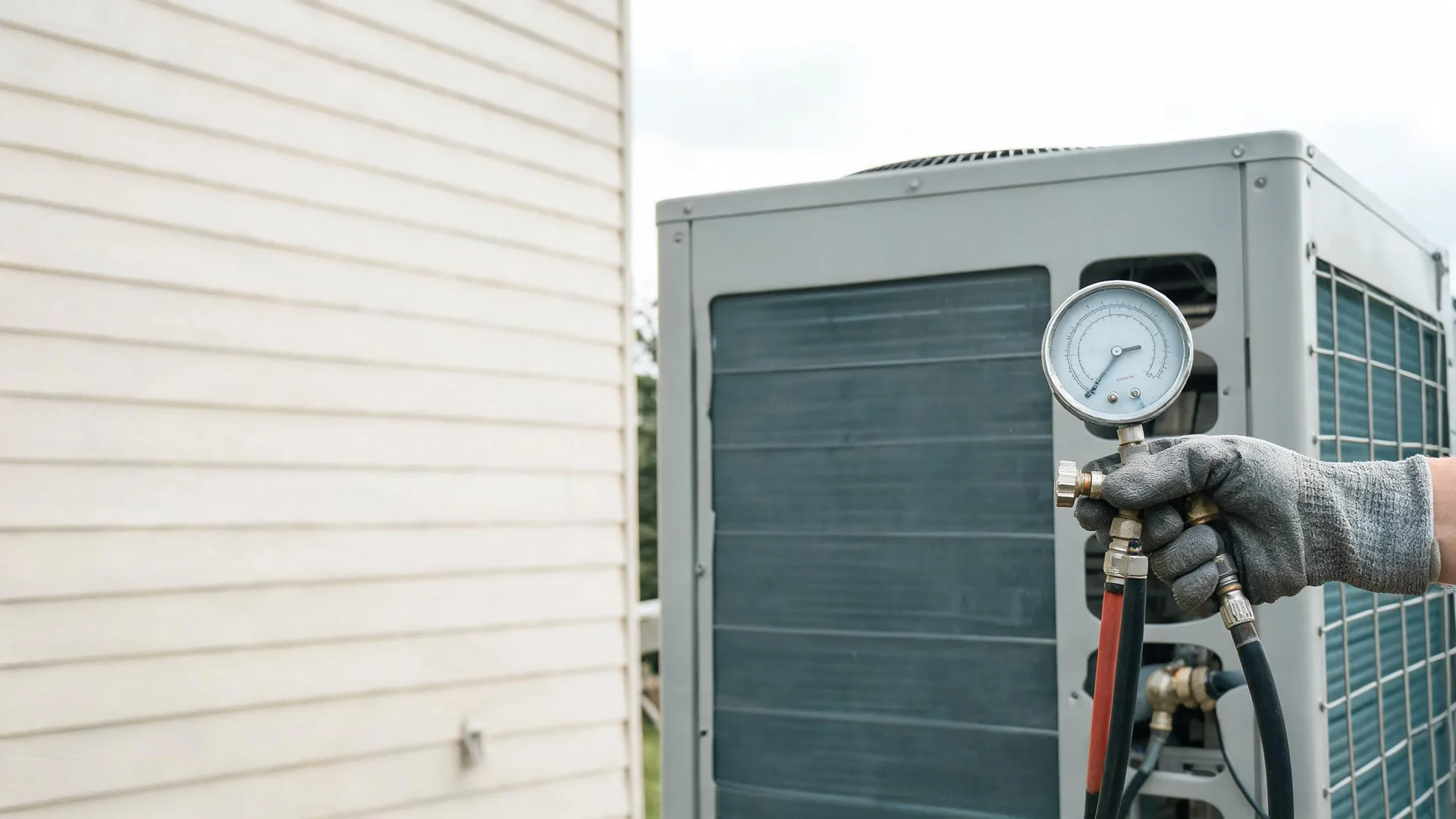
A diagnostic visit starts outside, not at the thermostat. The tech checks the outdoor unit first, looking at the coil, the fan, and whether the compressor is drawing the current it should. From there it's gauges on the refrigerant lines to see if the charge is where it needs to be, since low pressure shows up fast in how the system performs. Inside, the tech checks the air handler and the return air, because a system starved for airflow can mimic other problems that have nothing to do with the compressor or the charge. Electrical parts get tested directly, not guessed at. A capacitor either holds its rated charge or it doesn't, a contactor either closes cleanly or it's pitted, and a meter settles the question quickly. The point of all this is to find the one thing actually failing, not to replace parts until something works.