A stack of split firewood in a metal rack sits against the dark vertical-board exterior wall of a house, beside a gravel path with dry grass and pine trees under an overcast sky.

Heat Pump Repair in Twin Falls, ID

Tell us about the job

Takes about a minute. No obligation.

RepairHeat PumpTwin Falls County, ID
Step 1 of 2

What ZIP code is the job in?

Half the homes here were built in 1982 or later

Twin Falls County splits close to down the middle, half the homes built in 1982 or earlier, half in 1982 or later. That puts a lot of houses here within reach of a heat pump that still has years left in it, not some original unit from decades back.


A newer system is worth fixing

A heat pump that came with a newer house usually still has plenty of working life in it. When something goes wrong, repair makes more sense than replacement.

9 months
September through May, your system heats
2 months
July through August, it cools
21°F
the average winter night it heats against
83°F
the average summer afternoon it cools against
Isometric cutaway illustration of a small house showing interior rooms with furniture, an indoor air handler with flexible ducting, and refrigerant lines running to an outdoor condenser unit beside the building.
Your system heats September through May and cools July through August.

NOAA nClimDiv, 1991–2020 normals

Winter nights here average 21°F, but a heat pump in Twin Falls isn't fighting brutal summer heat the rest of the year.

A heat pump with a lighter year-round load tends to hold up better, so one here is more likely to still be in good shape when it breaks.

September is when a weak heat pump shows it

Cooling runs July through August
Heat runs September through May
28 damaging wind events from 2015 to 2024
If a newer heat pump breaks, get it looked atHalf the homes in Twin Falls County were built in 1982 or later.

A tech who comes out for a heat pump that's acting up starts by asking what you've noticed. Short cycling, warm air that isn't warm enough, ice that won't go away, a unit that runs but doesn't seem to do anything. That answer points to where they look first. They'll check the refrigerant charge, since a system low on charge struggles to move heat in either direction. They'll check the reversing valve, the part that switches the unit between heating and cooling, because a stuck valve can leave you heating when you want cooling or the other way around. They'll look at the outdoor coil and the defrost cycle, since a coil caked in ice means the defrost board or the sensor that triggers it isn't doing its job. Electrical connections and the contactor get checked too, since a heat pump cycles on and off far more than a furnace does and that wear adds up. By the time they're done, they can usually tell you exactly which part failed and why, not just that something did.

Repair it

If your system came with a newer house, it likely has plenty of life left. Repair is usually the right call.

Find a contractor
A man in a dark work shirt and brown pants carries a canvas tool bag as he steps up to a green front door on a porch with a potted shrub.
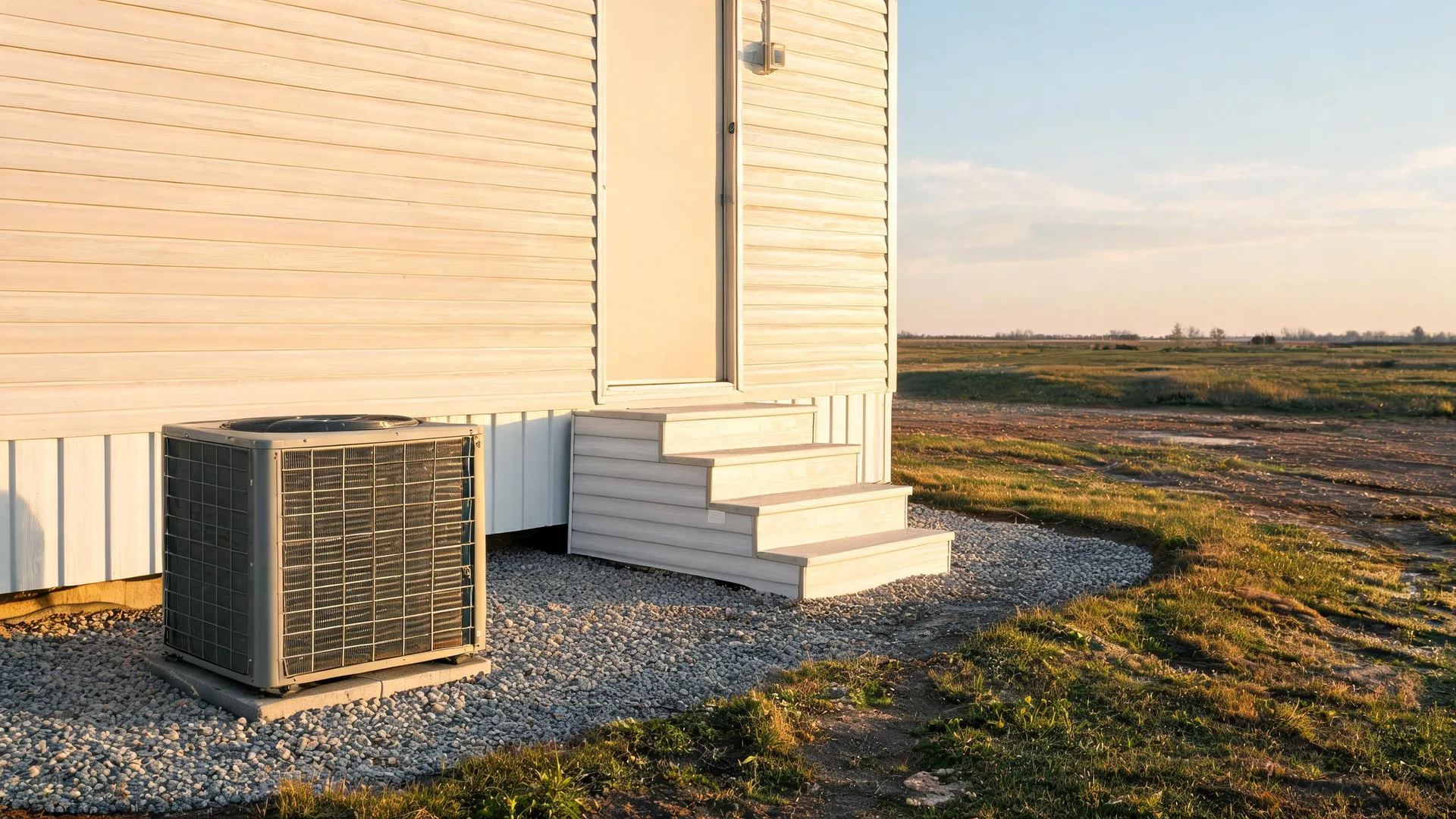
A gray heat pump condenser unit mounted on a concrete pad against the gray lap-siding exterior wall of a house.

It runs every month, so a tech reads the signs differently than they would on a furnace

A heat pump works every month of the year, heating in the cold months and cooling in the warm ones, so it never really gets the long off-season a furnace gets once spring comes. That doesn't mean the compressor is under heavy strain year round, only that it's the one running the show in every season, so any wear shows up on a different schedule than it would on a furnace. That's part of why the signs tend to build gradually instead of showing up all at once. A unit that short cycles, or takes longer each month to bring the house to temperature, or blows air that's running but not quite warm, is usually telling you a part is on its way out, not gone yet. Catching it at that stage is what keeps a repair a repair instead of a replacement.

What you can look at yourself

Check the outdoor unit for ice covering the coil or leaves and debris blocking airflow around it. Look at the air filter and swap it if it's dirty, since restricted airflow makes a heat pump work harder and can trigger a shutdown. Check the thermostat batteries and settings, and make sure the breaker for the unit hasn't tripped. Walk around the vents inside and feel whether air is actually moving.

What to leave alone

Don't open the outdoor unit's cabinet or touch the wiring inside it. Don't try to chip ice off the coil or hose it down, since that can damage the fins. If the unit is making a grinding or screeching noise, or tripping the breaker repeatedly, turn it off at the thermostat and leave it off until someone can look at it, rather than letting it keep cycling.

A heat pump that's struggling still tries to do its job, and that's the problem. If the charge is low, the compressor keeps running to chase a temperature it can't reach, and a compressor that runs hard on low charge is more likely to fail outright than one that gets shut down early. Ice on the outdoor coil works the same way. A little ice blocks some airflow, but the unit keeps running, the ice builds further, and now the whole coil is starved for air while the system keeps drawing power trying to push through it. A reversing valve that's starting to stick is often still working, just slower or less completely each cycle, and every cycle you run it in that state is wear on a part that was already going bad. None of this fixes itself by waiting. The machine doesn't know it's failing, it just keeps doing the only thing it knows how to do, and that's usually what turns a worn part into a replaced one.

A heat pump nearing the end of its life doesn't always announce it. Sometimes the compressor itself is worn, and no repair changes that. Other times it's a single part, a capacitor or a control board, failing inside a cabinet that's otherwise sound. The trick is telling those apart before you spend money. A contractor can check how the system is running against what it should be doing, not just whether it turns on. If the compressor is still strong and the rest of the unit is in decent shape, replacing one bad part makes sense. If the compressor is the problem, no other repair is worth doing first.