




An outdoor air conditioning condenser unit mounted on a concrete pad in front of a single-story suburban house.

Heat Pump Repair in Weiser, ID

Tell us about the job

Takes about a minute. No obligation.

RepairHeat PumpWashington County, ID
Step 1 of 2

What ZIP code is the job in?

A heat pump in Washington County switches modes twice a year, and both switches tend to expose whatever was already wearing out. Heat kicks on in September after sitting idle since spring, and cooling starts in July after months of running heat. That first startup in each direction puts a load on parts that may not have moved in months, like a reversing valve or a contactor. If something was marginal, this is when it shows. A unit that struggled last September is worth a look in August, before heat season asks it to work again.

9 months
September through May, your system heats
2 months
July through August, it cools
22°F
the average winter night it heats against
83°F
the average summer afternoon it cools against
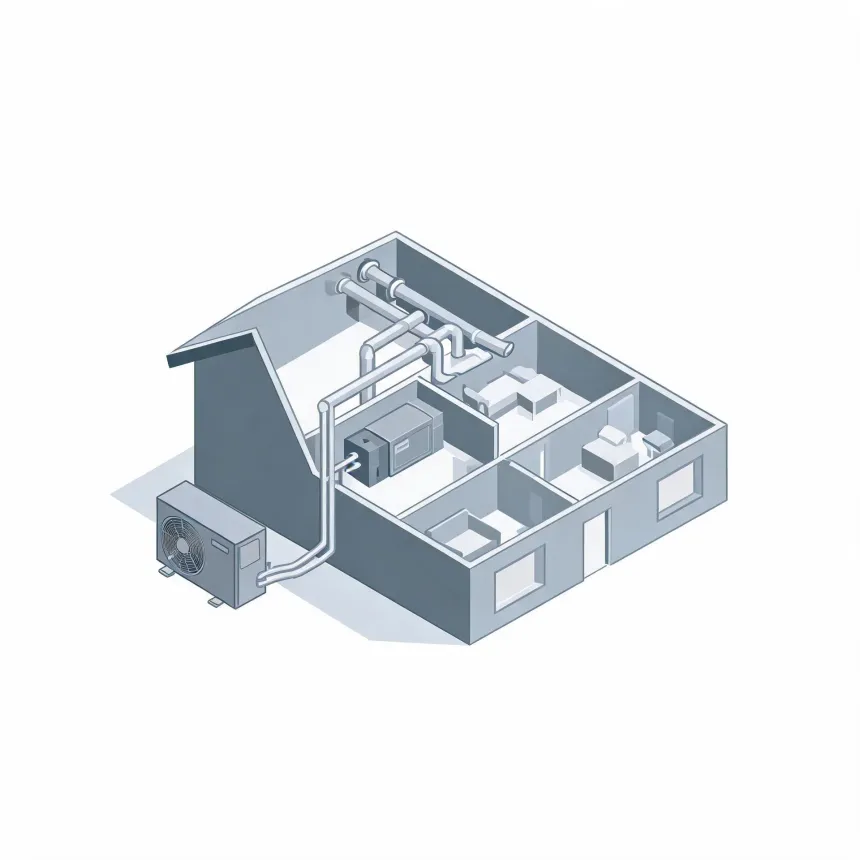
Isometric grayscale illustration of a cutaway house showing interior rooms, ducted air handler and duct runs, connected by pipes to an outdoor condenser unit beside the building.
Your system heats September through May and cools July through August.

NOAA nClimDiv, 1991–2020 normals

Weiser winters average 22°F overnight, nothing extreme for a heat pump built to handle cold.

A heat pump that struggles here is dealing with a worn part, not weather it can't handle.

An old house here isn't why your heat pump is struggling

Half the homes here were built by 1975
85 winter storms from 2015 to 2024
Winter nights average 22°F

A heat pump working harder than it should shows up on the power bill before it shows up as a breakdown. Idaho homes paid 11.52 cents per kilowatt-hour in 2024, so a unit running long cycles or short-cycling on a bad contactor is spending real money doing it. That's not a reason to assume the worst about the equipment. It's a reason to get the actual cause found, whether that's a weak capacitor, a low charge, or a part sticking when it shouldn't. Worth having someone look at it now rather than waiting for it to quit.

Get it looked at early

Problems tend to show up in the first weeks of the season, when the load hits a part that was already weak.

Find a contractor
A dark gray heat pump unit mounted on a concrete pad next to a house with gray siding and a stone veneer wall.

What a failing heat pump sounds and feels like before it quits

A heat pump that's failing rarely quits all at once. It'll run longer than it used to, blow air that's warm but not hot, or short cycle, kicking off a few minutes after it starts. Ice building up on the outdoor unit in defrost mode is normal for a few minutes at a time. Ice that stays, or spreads across the whole coil, means the defrost cycle or the reversing valve isn't doing its job. A hissing or bubbling sound near the lines can mean a refrigerant leak, and that's not something that fixes itself or gets better with time. Listen for a hard clunk when the system switches between heat and cool, or a hum with no airflow behind it, that's often a contactor or a capacitor giving out. None of these get better left alone. A unit straining to do its job now will keep straining until a part fails outright, usually on the coldest or hottest day it's asked to work hardest.

What you can check yourself

Look at the outdoor unit and clear away leaves, grass clippings or anything blocking the sides. Check the air filter and swap it if it's gray with dust. Make sure every supply vent inside is open and nothing is stacked in front of a return. Check the thermostat batteries if it has a screen that looks dim. Look at the breaker panel for anything tripped. These take a few minutes and rule out the simplest causes before anyone comes out.
What to leave alone

Don't open the outdoor unit's cabinet or touch the wiring behind the access panel. Don't try to clear ice off the coil by hand or with hot water. Don't add refrigerant or touch the lines, a low charge means a leak somewhere and that needs to be found, not covered up. If the breaker trips again after you reset it once, stop resetting it and leave it off until someone's looked at the unit.

Most heat pump failures trace back to a handful of parts, and they fail for ordinary reasons. The contactor is the switch that sends power to the outdoor unit, and it opens and closes every single cycle, so the contacts wear down and eventually pit or stick. A capacitor gives the compressor and fan motor the extra push they need to start, and it weakens with age until the motor strains to turn over or doesn't. The reversing valve is what lets the system switch between heat and cool, and when it sticks, the system runs but blows the wrong temperature air. Refrigerant doesn't get used up, so a low charge always means a leak, usually at a fitting or a coil that's corroded through over time. Outdoor coils get dirty or bent over years of sitting outside, and a dirty coil makes the whole system work harder to move heat in or out. None of these happen because a unit is old by itself. They happen because something ran enough cycles, or sat outside long enough, to wear out.

A part that fails outright is usually cheaper to fix than one that's limping along. A bad capacitor or contactor gets replaced on its own, and the rest of the system is fine once it's in. The harder calls come when the compressor itself is failing, since that's the most expensive part in the unit and it isn't sold separately from a full outdoor unit swap in most cases. A refrigerant leak is worth tracing before deciding anything, because a leak at a single fitting is a straightforward repair, while one running through a corroded coil often isn't worth chasing. Age by itself doesn't decide this. A unit that's been running long cycles for years on a dirty coil has worn its compressor down in a way a younger, well-kept unit hasn't. Get the actual part named before weighing repair against replacement, not just how old the unit is.