Heat pump stuck on emergency heat in Rexburg, ID

RepairHeat PumpMadison County, ID
Step 1 of 2

What ZIP code is the job in?

A heat pump switches itself to emergency heat when it senses the outdoor unit can't keep up, usually because of ice buildup, a stuck reversing valve, or a part that's failed outright. In Madison County, hard winters push heat pumps harder, and ice on the outdoor coil is the most common reason yours is locked into this mode. Emergency heat runs the backup electric strips instead of the compressor outside, which is why your house still feels warm but your power bill climbs fast if it stays this way. This isn't a setting you flip back once the weather clears. Something tripped it, and until that's found and fixed, the heat pump will keep leaning on backup heat alone. Left alone through a cold stretch here, that means higher bills and an outdoor unit that still isn't doing its job once the switch gets flipped back.

Why does your heat pump keep dropping into emergency heat here?

  • Winter nights average 14°F

    Nights this cold make the outdoor unit work harder to pull heat from the air, and that strain is what trips emergency heat in the first place.

  • Heat runs September through June

    Ten months of heating means your heat pump carries the load almost all year, so a failing part gets found fast instead of sitting unused.

  • Cooling runs July through July

    With only July free of heating, there's barely a stretch for the system to rest or for a developing problem to go unnoticed.

NOAA nClimDiv 1991-2020

How emergency heat actually works

  • A thermostat set to Emergency Heat locks out the compressor and runs backup heat strips or the furnace instead.
  • Normal operation reverses refrigerant flow through the reversing valve to pull heat from outside air even in cold weather.
  • The defrost board checks the outdoor coil on a timer and triggers a defrost cycle when frost builds past a set point.
  • A failed reversing valve, a stuck contactor, or a bad defrost sensor can force the system into emergency heat on its own.
  • Emergency heat uses electric strips or a gas furnace directly, skipping the outdoor unit and the compressor entirely.
  • A heat pump that stays in emergency heat through a stretch of single-digit nights is telling you the outdoor unit stopped contributing.

Your heat pump moves heat instead of making it, pulling warmth out of the outside air and pushing it inside through the reversing valve. That valve is what lets the same unit cool your house in July and heat it in January. When outdoor air gets cold enough, frost collects on the outdoor coil, and a defrost board watches for that on a timer, running a short defrost cycle to clear it before it cuts off airflow. Emergency heat is a separate path built for when that normal process fails. Flip the thermostat to Emergency Heat, or have the system do it automatically, and the compressor locks out completely. Everything shifts to electric strips or, in homes set up for it, the gas furnace, heating the house with no help from the outdoor unit at all. That's by design when the outdoor unit needs to come offline for a repair. It's a problem when the system puts itself there and won't come back. A reversing valve that's stuck, a contactor that's failed, or a defrost sensor giving the board bad readings can all force emergency heat on without you touching the thermostat. None of those fix themselves. If your system has been running this way through a run of single-digit nights, the outdoor unit isn't contributing anything, and the furnace or strips are carrying the whole load on their own.

A woman with dark shoulder-length hair in a beige knit sweater stands in a living room looking off to the side, with a sofa, lamp, houseplant and window behind her.
A woman with dark hair in a bun and a green button-up shirt looks off to the side in a living room with a gray sectional sofa, cushions, a woven pendant lamp, and a wall shelf with plants and a picture frame.
A woman with dark hair in a loose updo, wearing a white top and cream cardigan, sits on a light sofa with cushions and looks off to the side in a bright living room with white shelving, a mirror, a lamp and a large potted plant.
A woman with dark hair in a loose bun and a light grey sweatshirt sits near a curtained window, looking to the side and smiling slightly, with a blurred living room and sofa behind her.
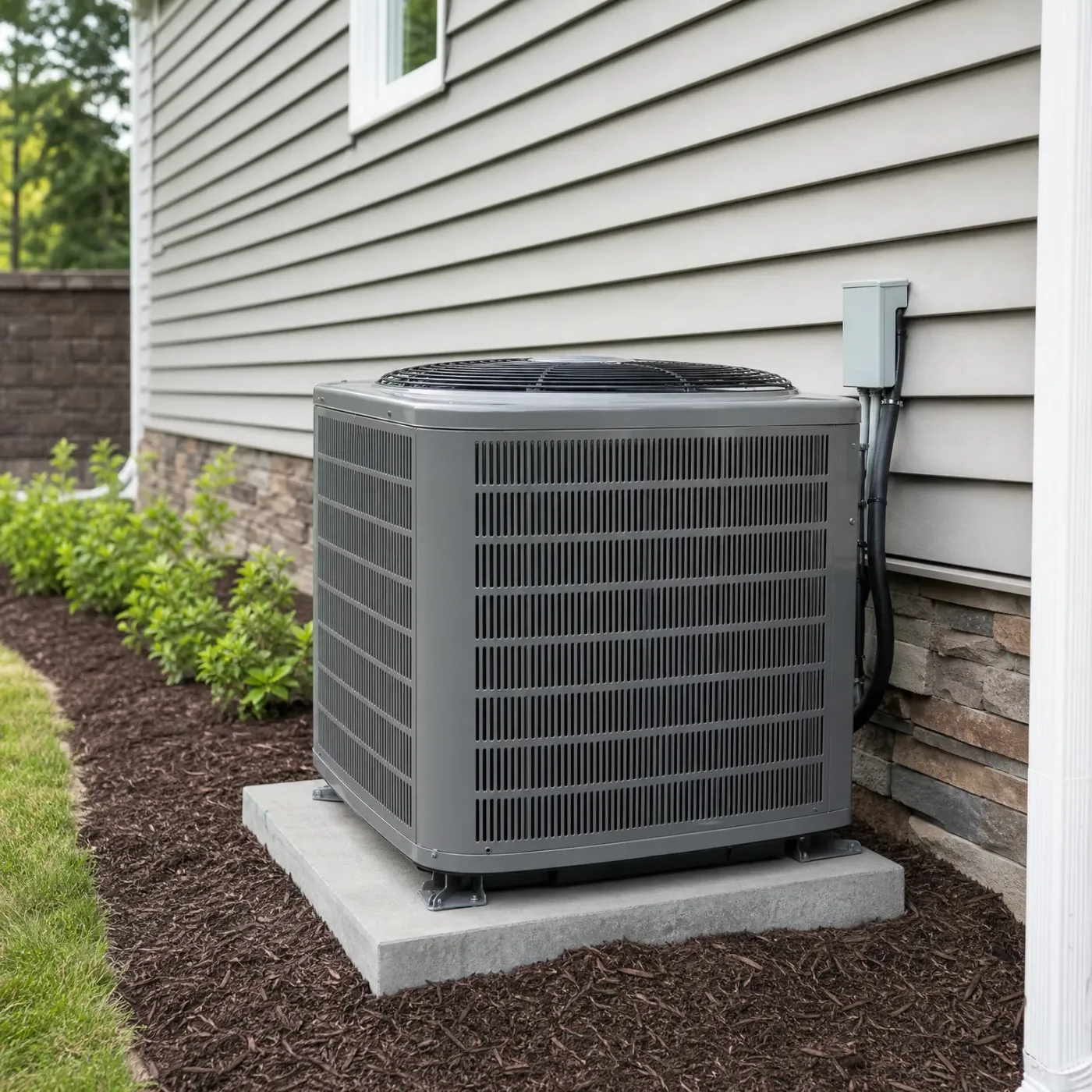
A gray outdoor condenser unit on a concrete pad beside a light-green sided house, surrounded by mulch, ornamental grasses and a shrub, with mowed lawn in the foreground.

Running as it should

This is your heat pump on a normal cycle, the outdoor fan turning and the coil clear. Refrigerant is moving heat in from the outside air, even on a cold Madison County night, and the thermostat stays off emergency heat because the system is keeping up on its own.

A gray outdoor air conditioning condenser unit on a concrete pad beside a house with light vinyl siding, with a gray electrical disconnect box and conduit on the wall to the right.

Stuck on backup heat

Frost or grime built up on the fins like this can stop the coil from pulling in heat, so the system locks out the compressor and leans on the backup heat strips instead. Once the thermostat shows Emergency Heat, the outdoor unit you see here has already stopped doing the work.

A woman with hair in a bun sits on a couch holding a sleeping child, both wrapped in a chunky knit blanket, in a dimly lit room with a lamp and bookshelves behind.
An older woman with gray hair in a patterned knit sweater smiles while looking to the side in a dimly lit kitchen, with a round loaf of bread on a wooden counter in the foreground and a lit oil lamp and potted plant on a windowsill behind her.

Your thermostat does not know the difference between emergency heat and the real thing. It just calls for warmth, and on emergency heat that warmth comes from strips or a furnace burning more to make it. If your house runs on gas backup like most in Madison County, that furnace is now doing all the work the heat pump used to share, night after night. Meanwhile the outdoor unit sits locked out, and if the reason is a frozen coil, the ice does not wait for a repair appointment. It sits there, and a coil that stays iced can bend fins or strain the fan motor behind it. So the problem does two things at once. It raises what you are paying to heat the house right now, and it lets whatever tripped the lockout keep sitting there getting worse. A system stuck like this on a cold Rexburg night is not pacing itself. It is running flat out on the more expensive option while the actual failure waits for someone to find it.

What a Stuck System Costs You

  • Emergency heat strips or furnace backup use more energy than the heat pump's normal cycle, so a stuck system raises your bill fast.
  • Most homes in Madison County heat with gas, so a heat pump stuck on emergency heat often means the backup furnace is carrying the whole house.
  • A reversing valve or defrost board that won't reset can leave the outdoor unit frozen over while the thermostat keeps calling for backup heat.
  • The longer the compressor stays locked out, the harder the backup system works through a Rexburg winter night to hold the temperature you set.
  • If the backup heat strips themselves are weak or failing, a house stuck on emergency heat may not keep up even as the bill climbs.
  • Ice left to build on the outdoor coil can damage the fan motor or coil fins, turning a switch stuck on emergency heat into a larger repair.
An outdoor air conditioner condenser unit on a concrete pad beside a house with beige horizontal siding, with conduit running from an electrical box on the wall.
Before you get your heat pump repair
A gray outdoor heat pump unit on a concrete pad beside a house with horizontal lap siding, connected by conduit and a flexible line to a wall-mounted disconnect box, with low shrubs and mulch nearby.
After you get your heat pump repair
A gray outdoor condenser unit on a concrete pad beside a house with horizontal siding and stone veneer, with a disconnect box and refrigerant lines on the wall, surrounded by mulch, shrubs, and lawn.

No calling every shop in Madison County

A licensed pro who repairs heat pumps in Madison County gets your request.

Skip calling shops to ask who repairs heat pumps in Madison County.

Find a licensed pro

You only hire the pro if you want to.

Stuck on Emergency Heat vs. Fixed

Stuck on emergency heat

  • The compressor stays locked out, so the furnace or heat strips carry the whole load until someone resets or repairs the system.
  • A gas furnace burning that much more during a Madison County winter shows up on the next bill, often before the problem gets diagnosed.
  • The outdoor unit sits idle, which hides whatever tripped it, be it a frozen coil, a bad defrost board, or a stuck reversing valve.
  • Every night below freezing adds to the backup system's runtime, and backup heat was never sized to run alone for weeks at a time.
  • Nothing about the thermostat setting fixes the actual fault, so it stays on emergency heat until a contractor finds what failed.

Back to normal cycle

  • The reversing valve shifts refrigerant flow correctly again, so the outdoor unit pulls heat from the air the way it's built to.
  • Your furnace or heat strips go back to backup duty only, stepping in when the heat pump actually needs the help, not every hour of the day.
  • The defrost board cycles as it should, clearing ice from the outdoor coil instead of letting it build until the system shuts itself down.
  • Your heating bill reflects a heat pump doing most of the work, with gas or strip heat covering the gaps instead of the whole job.
  • A contractor who works heat pumps through Madison County winters knows which part tends to fail first in weather like this.
A gray outdoor heat pump unit on a concrete pad beside a house with horizontal lap siding, with a conduit running to a wall-mounted disconnect box and a green shrub to the left.
The coil stays clean and the fins are clear, so the outdoor unit can pull heat from the air the way it's built to.
An outdoor air conditioner condenser unit on a concrete pad beside a house with horizontal vinyl siding, with refrigerant lines and an electrical disconnect box on the wall and dry leaves on the ground.
Dirty, frosted coil fins make the outdoor unit struggle, and that struggle is often what forced the switch to emergency heat.

What actually tells the heat pump to switch to emergency heat?

What actually tells the heat pump to switch to emergency heat?

A control board decides, not the thermostat alone

The thermostat has an emergency heat setting, but the switch usually comes from the defrost control board on the outdoor unit. That board watches a sensor on the coil. When it reads the coil as too cold for too long, or when the outdoor fan or compressor isn't drawing the current it should, the board locks out the compressor and signals the furnace or heat strips to take over. On a hard Madison County night, that's often ice on the coil that never cleared, or a reversing valve that didn't shift back after defrost. The thermostat screen just shows you what the board already decided.

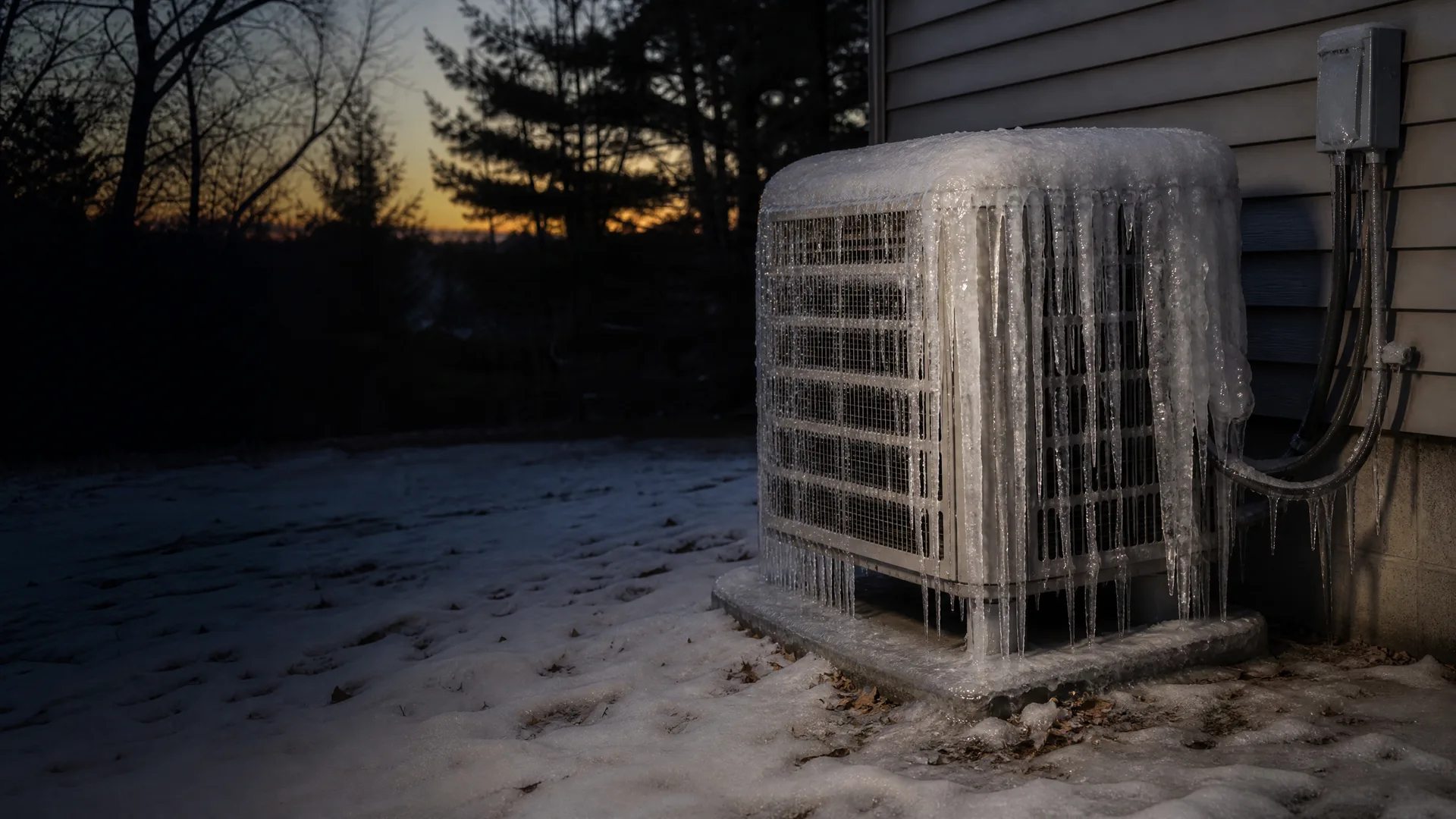
An outdoor air conditioning or heat pump unit encased in thick ice with hanging icicles, standing on a concrete pad beside a house with horizontal siding and an electrical box, with snow on the ground and a dusk sky behind bare trees.

Dawn comes up gray over the side yard, and the outdoor unit is sitting under a shell of ice, thick over the coil and climbing the cabinet sides. You can see your breath. The fan isn't turning. Somewhere behind you in the house the furnace has been running long stretches since about four, carrying heat the way it does when the pump gives up on itself, and the thermostat still reads the emergency heat setting you never touched. The grass around the unit's base is the only green left, melted back from whatever warmth is leaking out of the casing. Frost has worked into the louvers on the side panel. You stand there in your coat a minute before you go back in, the cold coming up through your boots off the Madison County ground.
Power here costs 13.44 cents per kilowatt-hour

At 13.44 cents per kilowatt-hour, running strips or a backup furnace fan around the clock costs real money fast. Since most homes here already lean on gas for heat, a stuck heat pump usually means that furnace is burning more to cover the gap.

EIA-861 2025

A gray outdoor condenser unit on a concrete pad beside a house with horizontal lap siding, with a wall-mounted disconnect box, conduit and insulated refrigerant lines, a shrub at left and gravel at right.

Working the way it should

The coil stays clear and the fan spins up whenever the thermostat calls for heat. Refrigerant lines run tight up the wall to the disconnect, and nothing on the unit is working harder than it needs to, even on a cold night.

An outdoor condenser unit on a concrete pad beside a horizontal-sided house, with insulated refrigerant lines running to a wall-mounted box, surrounded by bare dirt.

Working against itself

An older unit like this one has had more winters to wear the contacts, weaken the defrost board, or let a refrigerant leak go unnoticed. Any of those can be enough to push it into emergency heat and leave it there.

A closed laptop and a stoneware mug on a wooden table, with a kitchen counter, wood cabinets, white tile backsplash, potted plants and a window behind.

Your heat pump should come off emergency heat, not live on it

A heat pump stuck on emergency heat is telling you something failed, whether that's a frosted coil, a reversing valve that won't shift back, or a control board sending the wrong signal. It isn't a setting you should leave alone through a Madison County winter. Left stuck, the furnace or heat strips carry the whole load while the compressor sits idle, and that shows up on your bill long before anyone fixes the actual part.

Finding out which one it is means someone local looking at the outdoor unit, the board, and the thermostat together, not guessing from a phone call. That's one contractor who works on heat pumps in this area all winter, not a list of names to call and re-explain the same problem to five times. You get a diagnosis instead of a search.

A living room with a cream sofa and knit throw beside a window, with a wooden coffee table in the foreground holding a round woven tray, a small bowl, and a speckled vase of green leafy branches.
A dark standing-seam metal roof with a stone chimney in the foreground, with a conifer-covered hillside, dry grassland valley and snow-capped peaks under a partly cloudy sky behind.

No phone calls to make

Find a local pro

Asking costs nothing, and the choice to hire stays yours.

A heat pump stuck on emergency heat won't fix itself by spring. The longer the compressor stays locked out, the longer your furnace or strips carry the whole load through the rest of a Madison County winter. One call to a local contractor who works on these systems every season gets it looked at before the next cold night.